AI in Retail: 30% Efficiency Gain in US Operations within 12 Months

Implementing artificial intelligence strategically across US retail operations can realistically drive a 30% efficiency gain within the next 12 months by optimizing inventory, logistics, customer engagement, and workforce management.
The retail landscape in the United States is undergoing a profound transformation, driven by evolving consumer expectations and technological advancements. In this dynamic environment, the promise of
AI in Retail: Driving a 30% Efficiency Gain in US Operations within the Next 12 Months
is not just a bold claim but a tangible objective for forward-thinking businesses. This article explores how artificial intelligence is becoming the cornerstone of operational excellence, offering retailers an unprecedented opportunity to streamline processes, reduce costs, and enhance the customer journey.
Are you ready to unlock this potential?
The imperative for AI in US retail operations
The US retail sector faces persistent challenges, from fluctuating consumer demand and supply chain disruptions to intense competition and rising operational costs. In this context, merely maintaining the status quo is a recipe for stagnation. Retailers must actively seek innovative solutions to stay competitive and profitable. Artificial intelligence emerges as a powerful tool to address these complexities head-on, offering predictive capabilities and automation that human efforts alone cannot match.
AI’s ability to process vast amounts of data at speed allows retailers to gain actionable insights into every facet of their operations. This isn’t just about incremental improvements; it’s about fundamental shifts in how businesses operate, leading to significant efficiency gains across various departments. From optimizing inventory levels to personalizing customer interactions, AI is reshaping the retail paradigm.
Understanding the current challenges
- Supply Chain Volatility: Unpredictable global events and consumer behavior shifts create complex logistics.
- Labor Shortages: Difficulty in attracting and retaining talent impacts operational continuity and service quality.
- Rising Costs: Inflationary pressures on goods, transportation, and energy erode profit margins.
- Evolving Customer Expectations: Demand for seamless omnichannel experiences and instant gratification.
Addressing these challenges effectively requires more than traditional business intelligence. It demands a proactive, data-driven approach that AI can uniquely provide. By leveraging machine learning algorithms, retailers can anticipate problems before they arise and implement solutions with greater precision and speed.
Strategic areas for AI implementation to boost efficiency
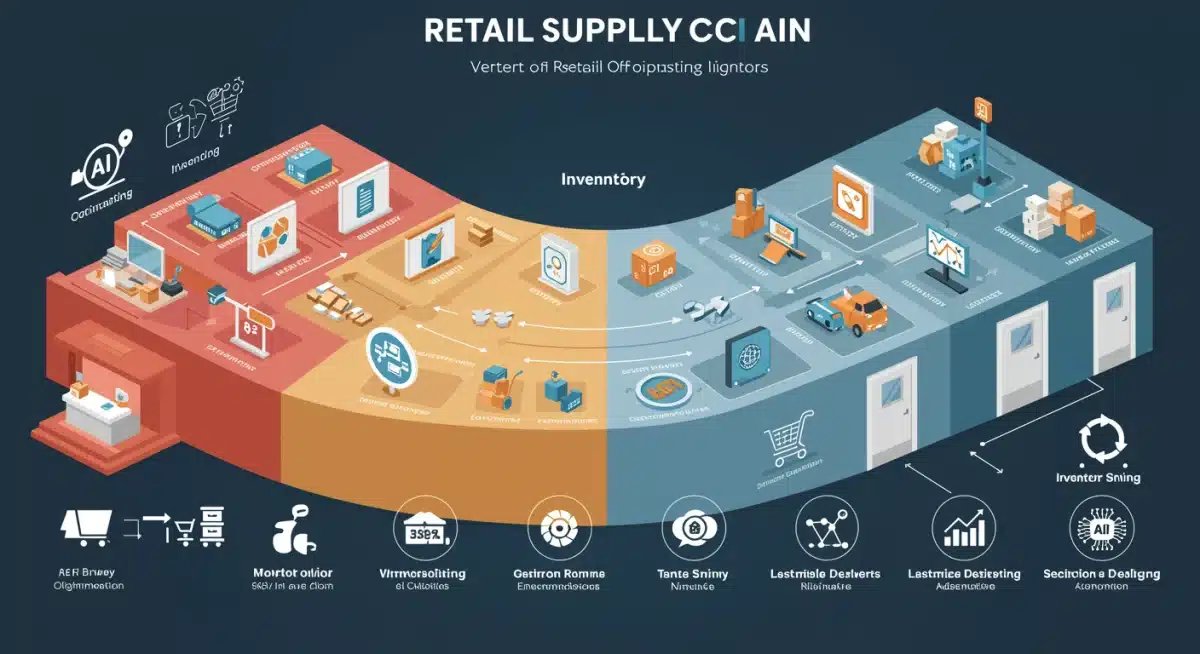
Achieving a 30% efficiency gain requires a targeted approach to AI implementation. Retailers must identify key operational areas where AI can deliver the most significant impact. These areas typically include supply chain management, inventory optimization, customer experience, and workforce management. Each of these domains presents unique opportunities for AI to streamline processes, reduce waste, and enhance decision-making.
The beauty of AI lies in its versatility. It can be tailored to address specific pain points within an organization, providing customized solutions that yield measurable results. A phased approach, starting with areas that offer immediate returns, can build momentum and demonstrate the value of AI across the enterprise.
Optimizing supply chain and logistics
The supply chain is often the most complex and costly aspect of retail operations. AI can revolutionize this area by providing predictive analytics for demand forecasting, optimizing routing for deliveries, and automating warehouse processes. This leads to reduced shipping times, lower fuel consumption, and fewer stockouts.
- Demand Forecasting: AI algorithms analyze historical sales data, seasonal trends, and external factors to predict future demand with high accuracy. This minimizes overstocking and understocking, reducing carrying costs and lost sales opportunities.
- Route Optimization: AI-powered logistics platforms can calculate the most efficient delivery routes, considering traffic, weather, and delivery windows. This reduces transportation costs and enhances delivery speed.
- Warehouse Automation: Robotics and AI-driven systems can automate tasks such as picking, packing, and sorting, significantly increasing throughput and reducing labor costs in distribution centers.
- Supplier Relationship Management: AI can analyze supplier performance data to identify reliable partners and negotiate better terms, ensuring consistent product availability and cost savings.
AI-driven inventory management and waste reduction
Inefficient inventory management is a major drain on retail profitability. Holding too much stock ties up capital and increases the risk of obsolescence, while too little stock leads to lost sales and dissatisfied customers. AI offers sophisticated solutions to strike the perfect balance, ensuring products are available when and where customers want them, without excessive overhead.
Beyond just stock levels, AI can also play a crucial role in identifying and mitigating waste throughout the product lifecycle. This includes reducing spoilage for perishable goods, minimizing returns through better product descriptions, and optimizing markdown strategies for slow-moving items. The cumulative effect of these optimizations contributes significantly to the targeted 30% efficiency gain.
Predictive inventory and replenishment
AI systems can analyze real-time sales data, promotional impacts, and even social media trends to predict inventory needs with unparalleled accuracy. This allows for automated reordering and dynamic stock allocation across different retail locations.
- Real-time Stock Monitoring: Sensors and AI-powered cameras can track inventory levels continuously, alerting staff to low stock or misplaced items.
- Dynamic Pricing: AI can adjust prices in real-time based on demand, competitor pricing, and inventory levels, maximizing revenue and minimizing unsold stock.
- Return Prediction and Management: AI can predict which products are likely to be returned and suggest interventions to reduce return rates, such as improved product information or personalized recommendations.
Enhancing customer experience and personalized engagement
While efficiency often focuses on back-end operations, AI’s impact on the customer experience is equally crucial for overall business success. A positive customer experience drives loyalty, increases sales, and reduces the need for costly customer support interventions. AI enables retailers to deliver highly personalized and seamless interactions across all touchpoints, from online browsing to in-store visits.
By understanding individual customer preferences and behaviors, AI can recommend relevant products, offer tailored promotions, and provide instant support. This level of personalization not only delights customers but also makes the sales process more efficient, converting browsers into buyers more effectively.
Personalized recommendations and marketing
AI algorithms analyze browsing history, purchase patterns, and demographic data to offer highly accurate product recommendations, significantly increasing conversion rates and average order value.
- Chatbots and Virtual Assistants: AI-powered chatbots provide instant customer support, answering queries, guiding purchases, and resolving issues 24/7, reducing the burden on human customer service teams.
- Personalized Marketing Campaigns: AI segments customers into highly specific groups, allowing for hyper-targeted email campaigns, social media ads, and in-app notifications that resonate more deeply with individual preferences.
- In-store Experience Enhancement: AI can power smart mirrors, interactive displays, and navigation apps that provide personalized suggestions and information to shoppers inside physical stores.
Workforce optimization and operational efficiency
The retail workforce is a critical asset, and AI can empower employees by automating mundane tasks, providing actionable insights, and optimizing scheduling. This not only improves employee satisfaction but also frees up staff to focus on higher-value activities, such as direct customer engagement and strategic planning.
By analyzing sales data, foot traffic, and employee performance, AI can help retailers make more informed decisions about staffing levels, task allocation, and training needs. This leads to a more productive and efficient workforce, directly contributing to the targeted 30% efficiency improvement.
AI-powered scheduling and task management
AI can create optimized employee schedules based on predicted customer traffic, sales forecasts, and individual employee availability and skills. This ensures adequate staffing during peak hours and reduces overstaffing during slower periods.
- Automated Task Assignment: AI can assign tasks to employees based on their location, skills, and current workload, streamlining operations and improving responsiveness.
- Performance Analytics: AI tools can analyze employee performance data to identify areas for improvement and tailor training programs, leading to a more skilled and efficient workforce.
- Fraud Detection: AI systems can monitor transactions and employee activities to detect and prevent internal and external fraud, protecting assets and reducing losses.
Measuring the 30% efficiency gain: KPIs and metrics
Achieving a 30% efficiency gain in US retail operations with AI is not just about implementing technology; it’s about diligently measuring its impact. Without clear key performance indicators (KPIs) and consistent monitoring, it’s impossible to validate the success of AI initiatives and make necessary adjustments. Retailers must establish baseline metrics before AI implementation and continuously track progress against these benchmarks.
The efficiency gain can manifest in various forms, from reduced operational costs and improved inventory turnover to increased sales per employee and faster order fulfillment. A holistic approach to measurement ensures that all aspects of the business benefiting from AI are accounted for, providing a comprehensive view of the ROI.
Key performance indicators for AI success
- Inventory Turnover Rate: Measures how quickly inventory is sold and replaced. AI should significantly increase this rate.
- Order Fulfillment Cycle Time: The time from order placement to delivery. AI-optimized logistics should drastically reduce this.
- Shrinkage Rate: The percentage of inventory lost due to damage, theft, or administrative errors. AI-powered surveillance and predictive analytics can lower this.
- Labor Cost as a Percentage of Revenue: Automation and optimized scheduling should lead to a reduction here, without compromising service.
- Customer Lifetime Value (CLTV): Enhanced personalization and experience driven by AI should increase customer loyalty and spending over time.
Navigating implementation challenges and future outlook
While the benefits of AI in retail are clear, successful implementation is not without its challenges. Data integration, talent acquisition, and organizational change management are critical hurdles that retailers must overcome. Integrating disparate data sources, ensuring data quality, and addressing privacy concerns are foundational steps.
Furthermore, the rapid pace of AI innovation means that retailers must adopt a mindset of continuous learning and adaptation. Staying abreast of emerging technologies and refining AI strategies will be key to sustaining efficiency gains and maintaining a competitive edge in the long term. The future of US retail is undeniably intertwined with the intelligent application of AI.
Overcoming common AI adoption hurdles
- Data Silos: Breaking down departmental data barriers to create a unified data ecosystem for AI to leverage.
- Skill Gap: Investing in training existing employees and hiring new talent with AI expertise.
- Ethical Considerations: Ensuring AI systems are fair, transparent, and protect customer privacy.
- Scalability: Designing AI solutions that can grow and adapt with the business’s evolving needs.
| Key Area | AI Impact for Efficiency |
|---|---|
| Supply Chain | Predictive demand forecasting, optimized logistics, automated warehousing. |
| Inventory Management | Real-time stock monitoring, dynamic pricing, waste reduction. |
| Customer Experience | Personalized recommendations, AI chatbots, targeted marketing. |
| Workforce Management | Optimized scheduling, automated task assignment, performance analytics. |
Frequently asked questions about AI in retail efficiency
With strategic planning and focused implementation, US retailers can begin realizing significant efficiency gains, potentially up to 30%, within 6 to 12 months. Early successes in areas like inventory optimization or customer service automation can provide quick wins and build momentum for broader AI adoption across the organization.
Key challenges include integrating disparate data sources, ensuring data quality and privacy, bridging the skill gap within the workforce, and managing organizational change. Overcoming these requires a clear AI strategy, investment in talent, and a commitment to continuous adaptation and learning.
While large chains have more resources, AI is increasingly accessible to small businesses through cloud-based solutions and AI-as-a-Service platforms. Small retailers can benefit from AI in areas like personalized marketing, automated customer support, and basic inventory management, scaling solutions to fit their needs and budget.
AI enhances customer experience through personalized product recommendations, efficient chatbot support, targeted marketing campaigns, and optimized in-store interactions. This level of personalization and responsiveness fosters loyalty, increases customer satisfaction, and ultimately drives sales more effectively.
Retailers should start by identifying specific pain points or inefficiencies. Conduct a data audit to assess available data quality. Then, pilot AI solutions in a controlled environment to demonstrate value, build internal expertise, and secure stakeholder buy-in before scaling up across operations.
Conclusion
The goal of achieving a 30% efficiency gain in US retail operations within the next 12 months through AI is not merely aspirational; it is an attainable reality for those willing to embrace technological transformation. From optimizing complex supply chains and fine-tuning inventory management to revolutionizing customer engagement and empowering the workforce, AI offers a comprehensive toolkit for operational excellence. While implementation challenges exist, the strategic adoption of AI promises not just efficiency, but a more resilient, responsive, and profitable future for retail businesses across the nation. The time to act is now, leveraging AI to redefine what’s possible in the competitive retail landscape.