ML for E-commerce Fraud: 18% US Loss Reduction by Q4 2025

Machine learning is revolutionizing fraud detection in e-commerce, offering a powerful solution to combat financial losses and is projected to reduce these losses by 18% in the US by Q4 2025 by identifying and mitigating fraudulent activities more effectively than traditional methods.
The digital marketplace, while offering unprecedented convenience and reach, remains a prime target for fraudsters. In this dynamic environment, the imperative to combat illicit activities has never been more critical. The focus on e-commerce fraud detection ML is not merely a technological trend but a strategic necessity, promising a substantial reduction in financial losses for US businesses by Q4 2025.
Understanding the E-commerce Fraud Landscape in the US
E-commerce fraud in the US represents a multifaceted challenge, evolving rapidly with technological advancements. Merchants face a constant battle against sophisticated schemes that can lead to significant financial and reputational damage. Understanding the prevalent types of fraud is the first step toward building resilient defense mechanisms.
The scale of the problem is immense, with billions of dollars lost annually. These losses stem from various sources, including chargebacks, stolen card usage, and sophisticated identity theft. As online transactions become more prevalent, so too does the opportunity for criminals to exploit vulnerabilities in traditional security systems.
Common Fraud Types Affecting US E-commerce
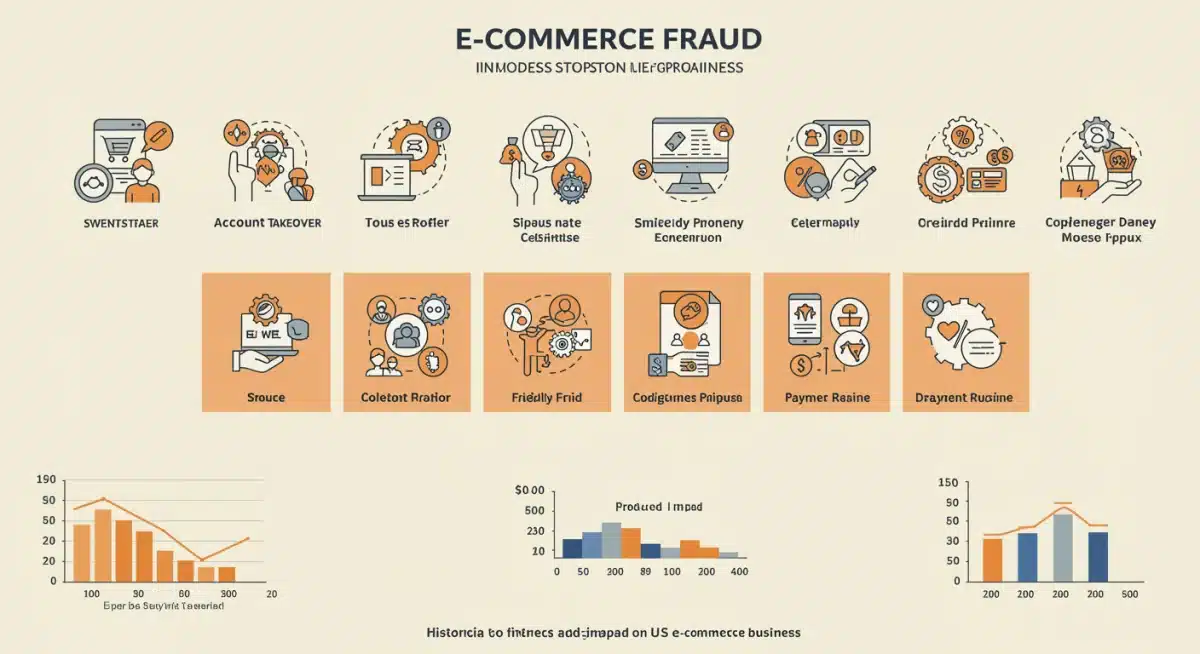
Fraudsters employ a range of tactics, each designed to exploit different weaknesses in the online shopping ecosystem. Recognizing these patterns is crucial for developing effective countermeasures.
- Account Takeover (ATO): Criminals gain unauthorized access to legitimate customer accounts, often using stolen credentials to make purchases or redeem loyalty points.
- Payment Fraud: This involves using stolen credit card numbers or other payment information to complete transactions. It often results in chargebacks, which are costly for merchants.
- Friendly Fraud (Chargeback Fraud): A customer makes a purchase, receives the item, and then falsely claims the transaction was unauthorized or the item was not received, leading to a chargeback.
- Bot Attacks: Automated bots are used to test stolen card details, scalp limited-edition products, or exploit promotional offers, overwhelming systems and causing financial loss.
The financial ramifications extend beyond direct monetary losses. They include operational costs associated with investigating and resolving fraudulent transactions, potential penalties from payment processors, and a decline in customer trust. The complexity and volume of these threats necessitate a paradigm shift in how e-commerce businesses approach security.
Staying ahead of fraudsters requires continuous vigilance and adaptation. Traditional rule-based systems, while foundational, often struggle to keep pace with new and evolving fraud schemes. This limitation underscores the growing need for more dynamic and intelligent solutions, such as those powered by machine learning.
The Rise of Machine Learning in Fraud Detection
Machine learning (ML) has emerged as a transformative force in the realm of fraud detection, offering capabilities that far surpass conventional methods. Its ability to process vast datasets, identify subtle patterns, and adapt to new threats makes it an invaluable asset for e-commerce businesses.
Unlike rigid, pre-programmed rules, ML algorithms can learn from historical data, dynamically adjust their detection models, and even flag previously unseen fraudulent behaviors. This adaptability is particularly critical in the fast-paced and ever-changing landscape of online fraud.
How ML Algorithms Detect Fraud
ML systems analyze numerous data points associated with each transaction, going beyond simple checks to build a comprehensive risk profile. This deep analysis allows for more accurate and proactive fraud prevention.
- Behavioral Analytics: ML models can learn typical customer behavior, such as purchasing habits, browsing patterns, and device usage. Deviations from these norms can signal potential fraud.
- Anomaly Detection: Algorithms are trained to identify transactions that stand out as unusual or abnormal compared to the vast majority of legitimate transactions.
- Predictive Modeling: By analyzing historical data of both fraudulent and legitimate transactions, ML can predict the likelihood of new transactions being fraudulent, even in real-time.
- Network Analysis: ML can map connections between various data points, such as IP addresses, email addresses, and payment methods, to uncover fraud rings and coordinated attacks.
The strength of ML lies in its iterative learning process. As more data becomes available, the models become more refined and accurate, leading to a continuous improvement in detection rates and a reduction in false positives. This continuous learning cycle is paramount for maintaining robust defenses against evolving threats.
The integration of ML into fraud detection systems marks a significant leap forward, enabling businesses to move from reactive responses to proactive prevention. This shift is crucial for protecting revenue and maintaining customer trust in the competitive e-commerce market.
Key ML Techniques for E-commerce Fraud Prevention
A variety of machine learning techniques are employed in fraud detection, each with its unique strengths and applications. The choice of technique often depends on the specific type of fraud being targeted and the characteristics of the available data.
These techniques range from supervised learning models, which learn from labeled data (known fraudulent or legitimate transactions), to unsupervised methods, which identify anomalies without prior labeling. Hybrid approaches often combine the best of both worlds for enhanced accuracy.
Supervised Learning Models
Supervised learning is widely used when historical data with clear labels of ‘fraudulent’ or ‘legitimate’ transactions is available. These models are trained to classify new transactions based on the patterns learned from this labeled data.
- Logistic Regression: A foundational statistical model used for binary classification, predicting the probability of a transaction being fraudulent.
- Decision Trees and Random Forests: These models make decisions based on a series of rules, effectively handling complex relationships within data and providing interpretable insights.
- Support Vector Machines (SVMs): SVMs find an optimal hyperplane to separate data points into different classes, proving effective in high-dimensional spaces.
- Neural Networks: Particularly deep learning models, excel at processing large, complex datasets and identifying intricate patterns that might be missed by other methods.
The effectiveness of supervised learning models heavily relies on the quality and quantity of the training data. A well-curated dataset ensures that the model learns accurate distinctions between genuine and fraudulent activities, minimizing both missed fraud and false alarms.
Unsupervised Learning and Hybrid Approaches
In scenarios where labeled fraud data is scarce, unsupervised learning techniques become invaluable. These methods focus on identifying anomalies or unusual patterns in the data without explicit prior knowledge of what constitutes fraud.
Clustering algorithms, for instance, can group similar transactions together, making it easier to spot outliers that may indicate fraudulent behavior. Anomaly detection algorithms specifically aim to identify data points that deviate significantly from the norm.
Hybrid models often combine supervised and unsupervised techniques to leverage their respective strengths. For example, an unsupervised model might first flag suspicious transactions, which are then reviewed and used to train a supervised model, creating a continuous feedback loop for improvement. This blended approach offers robust protection against both known and emerging fraud threats.
Implementing ML for Fraud Detection: Challenges and Best Practices
Implementing machine learning solutions for fraud detection in e-commerce, especially in the US market, involves navigating several complexities. While the potential benefits are substantial, businesses must address challenges related to data, integration, and model management to achieve optimal results.
A successful implementation requires not only robust technology but also a strategic approach that considers the unique operational environment of each business. This includes understanding the specific types of fraud prevalent in their sector and the characteristics of their customer base.
Common Implementation Challenges
Businesses often encounter hurdles when deploying ML-based fraud detection systems. Awareness and proactive planning can help mitigate these issues.
- Data Quality and Availability: ML models are only as good as the data they are trained on. Incomplete, inconsistent, or biased data can lead to inaccurate predictions and poor performance.
- Integration with Existing Systems: Seamless integration with current e-commerce platforms, payment gateways, and CRM systems can be technically challenging and time-consuming.
- False Positives and Negatives: A high rate of false positives can disrupt legitimate transactions and frustrate customers, while false negatives mean fraudulent activities slip through the net. Balancing these is a delicate act.
- Evolving Fraud Tactics: Fraudsters constantly adapt, requiring ML models to be continuously updated and retrained to remain effective against new schemes.
Addressing these challenges requires a combination of technical expertise, strategic foresight, and a commitment to continuous improvement. Investing in data governance, robust integration tools, and dedicated data science teams can significantly enhance implementation success.
Best Practices for Effective ML Deployment
To maximize the efficacy of ML in fraud detection, businesses should adhere to several best practices. These guidelines help ensure that the deployed systems are both powerful and practical.
Start with a clear definition of what constitutes fraud for your business and gather high-quality, labeled data. This foundational step is critical for training accurate models that reflect real-world scenarios. Continuously monitor model performance and retrain models regularly to adapt to new fraud patterns. This iterative process ensures that the detection system remains effective against evolving threats.
Furthermore, ensure that the ML system integrates smoothly with existing operational workflows to minimize disruption. A user-friendly interface for analysts to review flagged transactions is also paramount, enabling quick decision-making and reducing manual effort. Finally, prioritize customer experience by minimizing false positives; a good fraud detection system should not impede legitimate transactions.
The Economic Impact: Reducing Losses by 18% in the US by Q4 2025
The projection of reducing e-commerce fraud losses by 18% in the US by Q4 2025 through machine learning is not an arbitrary figure; it reflects a growing confidence in ML’s capabilities and its increasing adoption across the industry. This ambitious target signifies a substantial positive economic impact for businesses and the broader economy.
Achieving this reduction means billions of dollars saved annually, which can be reinvested into growth, innovation, and improved customer experiences. It also translates to enhanced operational efficiency, as fewer resources are diverted to managing and remediating fraud.
Quantifiable Benefits for E-commerce Businesses
The financial advantages of effective ML-driven fraud detection are multifaceted, directly impacting a company’s bottom line and long-term sustainability.
- Direct Loss Reduction: Preventing fraudulent transactions before they occur significantly cuts down on chargeback costs, merchandise loss, and associated fees.
- Operational Efficiency: Automating fraud detection reduces the need for manual review, freeing up human resources to focus on more strategic tasks.
- Improved Customer Trust: A secure shopping environment builds customer confidence, encouraging repeat business and positive brand perception.
- Reduced False Declines: Accurate ML models minimize the rejection of legitimate transactions, preventing lost sales and customer frustration.
Beyond these direct benefits, the peace of mind that comes with robust fraud protection allows businesses to focus on innovation and expansion without the constant threat of financial vulnerability. This enables a more dynamic and competitive market environment.
The 18% reduction target underscores the transformative potential of ML, positioning it as a critical investment for any e-commerce business looking to thrive in the digital age. It represents a significant step towards a more secure and profitable online retail ecosystem.
Future Trends and Innovations in ML Fraud Detection
The field of machine learning for fraud detection is continuously evolving, with new technologies and methodologies emerging regularly. Staying abreast of these trends is essential for businesses seeking to maintain a leading edge in fraud prevention. The future promises even more sophisticated and integrated solutions.
Innovations are driven by advancements in AI research, increased data availability, and the ever-present need to counter increasingly complex fraud schemes. The emphasis is shifting towards more proactive, predictive, and holistic security frameworks.
Emerging Technologies and Approaches
Several key areas are poised to shape the next generation of ML-driven fraud detection.
- Explainable AI (XAI): As ML models become more complex, understanding why a model makes a particular decision becomes crucial. XAI aims to provide transparency, helping analysts understand and trust the fraud detection system’s recommendations.
- Federated Learning: This approach allows multiple organizations to collaboratively train a shared ML model without directly sharing their raw data, enhancing privacy and enabling more robust fraud detection across a wider dataset.
- Real-time Behavioral Biometrics: Analyzing subtle user behaviors, such as typing speed, mouse movements, and navigation patterns, in real-time can provide strong indicators of identity and potential fraud.
- Quantum Machine Learning: While still in its early stages, quantum computing has the potential to revolutionize ML by processing vast datasets and complex algorithms at speeds currently unimaginable, offering unprecedented fraud detection capabilities.
These advancements promise to make fraud detection even more accurate, efficient, and resilient. The integration of these cutting-edge technologies will empower businesses to identify and mitigate fraud with greater precision, further securing the e-commerce landscape.
The continuous evolution of ML techniques ensures that fraud detection remains a dynamic and responsive field, constantly adapting to new threats. Investing in these future trends will be key for businesses aiming to stay ahead of the curve and protect their digital assets effectively.
Integrating Fraud Detection with Business Strategy
Effective fraud detection is not merely an IT function; it is a critical component of overall business strategy. For e-commerce businesses in the US, integrating machine learning fraud detection into their strategic planning is essential for sustainable growth and competitive advantage. This involves aligning security measures with customer experience goals and operational efficiency.
A holistic approach ensures that fraud prevention efforts support, rather than hinder, business objectives. It means viewing security as an enabler of trust and growth, rather than just a cost center.
Strategic Considerations for E-commerce Leaders
Businesses must consider several strategic elements when incorporating ML fraud detection into their operations.
- Customer Experience: Implement fraud detection systems that are seamless and minimally intrusive to legitimate customers. False positives can lead to abandoned carts and lost sales, undermining the very purpose of e-commerce.
- Scalability: Choose ML solutions that can scale with business growth, handling increasing transaction volumes and adapting to new markets without compromising performance.
- Regulatory Compliance: Ensure that fraud detection practices comply with relevant data privacy regulations (e.g., CCPA, state-specific laws) and payment industry standards (e.g., PCI DSS).
- Talent and Training: Invest in training staff or hiring data scientists and fraud analysts who can effectively manage, interpret, and optimize ML models.
By embedding fraud detection into the core business strategy, companies can foster a culture of security that permeates all levels of the organization. This proactive stance not only protects assets but also enhances brand reputation and builds long-term customer loyalty.
The strategic integration of ML fraud detection transforms it from a defensive measure into a powerful tool for business optimization, contributing directly to achieving ambitious goals like the 18% reduction in losses by Q4 2025.
| Key Aspect | Brief Description |
|---|---|
| ML Impact Goal | Reduce US e-commerce fraud losses by 18% by Q4 2025. |
| Core Mechanism | Machine learning algorithms analyze data for patterns and anomalies. |
| Key Benefits | Direct loss reduction, operational efficiency, increased customer trust. |
| Future Outlook | Emerging tech like XAI, federated learning, and real-time biometrics. |
Frequently Asked Questions About ML in E-commerce Fraud Detection
Machine learning excels at detecting various fraud types, including payment fraud (stolen credit cards), account takeover (ATO), friendly fraud (chargebacks), and bot attacks. Its adaptability allows it to identify both known patterns and emerging, novel fraudulent schemes by analyzing large datasets for anomalies and suspicious behaviors.
ML reduces losses by proactively identifying and preventing fraudulent transactions in real-time, minimizing chargebacks and merchandise loss. It also improves operational efficiency by automating detection processes, freeing up resources, and reducing false positives, which prevents legitimate sales from being declined and enhances customer satisfaction.
Key challenges include ensuring high-quality and sufficient data for training, seamlessly integrating ML systems with existing e-commerce platforms, balancing false positives and negatives, and continuously updating models to counter evolving fraud tactics. Overcoming these requires robust data governance and technical expertise.
This target is significant because it represents billions of dollars saved annually for US businesses, allowing for reinvestment in growth and innovation. It signifies a major improvement in security posture, boosts consumer confidence, and enhances operational efficiency, solidifying ML’s role as a critical strategic asset in the digital economy.
Future innovations include Explainable AI (XAI) for transparency, federated learning for collaborative model training with privacy, real-time behavioral biometrics for enhanced user authentication, and the potential of quantum machine learning for unprecedented processing power. These advancements aim to make detection more accurate, efficient, and proactive.
Conclusion
The journey towards achieving an 18% reduction in US e-commerce fraud losses by Q4 2025 through machine learning is a testament to the power of advanced analytics and strategic implementation. By embracing ML, businesses can not only mitigate financial risks but also foster a more secure and trustworthy online environment for consumers. The continuous evolution of ML techniques, coupled with a strategic approach to integration and talent development, will be paramount in maintaining this momentum and securing the future of digital commerce against an ever-adapting adversary. This proactive stance will undoubtedly redefine the landscape of e-commerce security.