Federal Accessibility Standards: 6-Month WCAG 2.2 Compliance Roadmap

Achieving WCAG 2.2 compliance within six months is crucial for digital commerce platforms navigating federal accessibility standards, requiring a strategic, phased approach to ensure inclusivity and avoid legal liabilities.
In today’s interconnected world, ensuring an accessible digital presence isn’t just good practice; it’s a legal imperative, particularly concerning federal accessibility standards for digital commerce. With the evolution of Web Content Accessibility Guidelines (WCAG) to version 2.2, businesses engaging in online transactions face a pressing need to update their platforms. This article provides a comprehensive 6-month roadmap to guide your organization toward WCAG 2.2 compliance, fostering inclusivity and mitigating potential legal risks.
Understanding the Mandate: Federal Accessibility and WCAG 2.2
The landscape of digital commerce is continually shaped by evolving legal frameworks, with federal accessibility standards at the forefront. These mandates, often rooted in acts like the Americans with Disabilities Act (ADA), aim to ensure that digital platforms are usable by everyone, including individuals with disabilities. WCAG 2.2 represents the latest iteration of these guidelines, building upon previous versions to address new digital interaction patterns and technologies.
For businesses operating in digital commerce, understanding the nuances of WCAG 2.2 is not merely an academic exercise; it’s a critical component of risk management and market expansion. Non-compliance can lead to costly lawsuits, reputational damage, and exclusion of a significant customer base. Conversely, achieving compliance opens doors to a broader audience and reinforces a commitment to corporate social responsibility.
The Evolution of WCAG and its Federal Impact
- WCAG 2.0 (2008): Established foundational principles for web accessibility.
- WCAG 2.1 (2018): Expanded to address mobile accessibility and low vision.
- WCAG 2.2 (2023): Introduced new success criteria, particularly focusing on cognitive accessibility, input modalities, and discoverability.
The impact of federal accessibility standards extends across various sectors, from government agencies to private entities serving the public. For digital commerce, this means that online stores, payment portals, and customer service interfaces must adhere to these guidelines. The shift to WCAG 2.2 signifies a proactive step towards a more inclusive digital ecosystem, demanding that businesses adapt their strategies and technologies accordingly.
In conclusion, grasping the core tenets of federal accessibility standards and WCAG 2.2 is the foundational step for any digital commerce entity. It’s about recognizing the legal obligations and embracing the ethical imperative to make digital spaces accessible to all users, thereby enhancing both brand value and market reach.
Month 1: Initial Assessment and Strategic Planning
The first month of your WCAG 2.2 compliance journey is dedicated to a thorough initial assessment and the formulation of a strategic plan. This phase is crucial for establishing a baseline, identifying potential challenges, and allocating resources effectively. Without a clear understanding of your current accessibility posture, subsequent remediation efforts could be misdirected or inefficient.
Begin by conducting a comprehensive audit of your existing digital commerce platform. This audit should evaluate all key user flows, from browsing products to completing purchases and accessing customer support. Engage accessibility experts, either internal or external, to perform automated and manual testing against WCAG 2.2 success criteria. This dual approach ensures both broad coverage and the identification of nuanced accessibility barriers that automated tools might miss.
Key Activities for Month 1
- Accessibility Audit: Conduct a detailed review of your entire digital commerce ecosystem, including websites, mobile apps, and any related digital interfaces, against WCAG 2.2 guidelines.
- Stakeholder Identification: Identify all internal stakeholders, including development, design, legal, marketing, and customer service teams, who will be integral to the compliance process.
- Resource Allocation: Determine the necessary budget, personnel, and tools required for the project.
- Risk Assessment: Evaluate potential legal and reputational risks associated with non-compliance.
Following the audit, prioritize the identified accessibility issues based on their severity, impact on user experience, and ease of remediation. Develop a detailed project plan that outlines specific tasks, timelines, and responsibilities for each phase of the 6-month roadmap. This plan should be flexible enough to accommodate unforeseen challenges but structured enough to maintain momentum.
Establishing clear communication channels among all stakeholders is also vital during this initial month. Regular meetings and progress reports will ensure everyone is aligned with the project’s goals and aware of their roles. This foundational planning sets the stage for a successful and efficient compliance process, ensuring that the subsequent months are spent on targeted and impactful remediation.
Month 2-3: Remediation and Design Implementation
With a solid assessment and strategic plan in place, months two and three shift focus to the core work of remediation and design implementation. This phase involves actively addressing the accessibility issues identified in the initial audit and integrating WCAG 2.2 principles into your digital commerce platform’s design and development processes. It’s a period of intensive work where changes are made to code, content, and user interface elements.
Prioritize remediation efforts based on the risk assessment conducted in Month 1. Start with high-impact issues that significantly impede user access or present the highest legal risk. This might include ensuring proper keyboard navigation, adding alternative text to images, improving color contrast, or making form fields more accessible. Involve your design and development teams closely, providing them with clear guidelines and access to accessibility resources.
During this period, it’s also crucial to begin embedding accessibility into your ongoing design and development workflows. This means moving beyond a reactive approach to a proactive one, where accessibility is considered from the outset of any new feature or product development. Implementing design systems that incorporate accessible components can significantly streamline future efforts.
Key Remediation Areas
- Code Adjustments: Modifying HTML, CSS, and JavaScript to meet WCAG 2.2 technical requirements, including ARIA attributes and semantic HTML.
- Content Enhancements: Ensuring all textual content is clear, concise, and easy to understand, with proper headings, link descriptions, and transcripts for multimedia.
- UI/UX Redesign: Improving visual design elements such as color contrast, font sizes, and interactive components to be more perceivable and operable for users with diverse needs.
Regular internal testing should accompany remediation efforts to ensure that changes are effective and do not introduce new accessibility barriers. This iterative process of fixing and re-testing is vital for maintaining progress and catching issues early. The goal by the end of Month 3 is to have addressed the most critical accessibility issues and to have established a more accessibility-aware development culture within your organization.
Month 4: Comprehensive Testing and Quality Assurance
Month four marks a critical juncture in the 6-month roadmap, focusing on comprehensive testing and quality assurance to validate your remediation efforts. This phase is about rigorously verifying that all implemented changes effectively meet WCAG 2.2 success criteria and that your digital commerce platform is genuinely accessible to all users. A multi-faceted testing approach is essential to capture a wide range of potential issues.
Begin with a second round of expert accessibility audits, preferably by a different set of auditors to gain a fresh perspective. These audits should again combine automated tools for broad coverage with manual testing by experienced accessibility professionals. Focus on areas that underwent significant changes during remediation and re-evaluate previously identified issues to ensure they are fully resolved.
Beyond expert audits, engage in user testing with individuals with disabilities. This is arguably the most critical component of this phase, as it provides invaluable real-world feedback on the usability and accessibility of your platform. Recruit a diverse group of testers with various disabilities, such as visual impairments, hearing impairments, motor disabilities, and cognitive disabilities, to ensure a holistic evaluation.
Testing Methodologies
- Automated Accessibility Scanners: Utilize tools like axe-core, Lighthouse, or WAVE for quick checks of common issues.
- Manual Code Review: Developers manually inspect code for semantic HTML, ARIA roles, and keyboard navigability.
- Assistive Technology Testing: Test with screen readers (e.g., JAWS, NVDA, VoiceOver), screen magnifiers, and speech recognition software.
- User Acceptance Testing (UAT) with Users with Disabilities: Observe and gather feedback from actual users with disabilities interacting with your platform.
Document all findings meticulously, including any new issues discovered or instances where previous fixes were insufficient. Prioritize these findings for immediate attention and schedule rapid remediation cycles. The objective of Month 4 is to achieve a high degree of confidence that your digital commerce platform is on track for WCAG 2.2 compliance, backed by robust testing and user validation.
Month 5: Documentation and Training
As you approach the final stages of your 6-month compliance roadmap, Month 5 shifts its focus to crucial documentation and comprehensive training. This phase is vital not only for cementing your current compliance but also for ensuring long-term adherence to federal accessibility standards and WCAG 2.2. Effective documentation serves as a reference point, while training empowers your team to maintain accessibility going forward.
Start by compiling all relevant documentation related to your accessibility efforts. This includes your accessibility policy, a detailed report of the audit findings, remediation steps taken, and testing results. Create an accessibility statement for your digital commerce platform, clearly outlining your commitment to accessibility, the standards you adhere to (WCAG 2.2 Level AA, for instance), and how users can report accessibility barriers.
Simultaneously, develop and deliver comprehensive accessibility training programs for all relevant teams. This includes designers, developers, content creators, quality assurance testers, and customer support staff. The training should be tailored to each role, providing practical guidance on how to incorporate accessibility best practices into their daily work. For instance, developers might learn about semantic HTML and ARIA attributes, while content creators focus on clear language and alternative text for images.
Essential Documentation and Training Components
- Accessibility Policy: A formal statement outlining your organization’s commitment to digital accessibility.
- Accessibility Statement: A public-facing document on your website detailing your compliance efforts and contact information for feedback.
- Internal Accessibility Guidelines: A living document for design and development teams to follow.
- Role-Specific Training Modules: Customized training for different departments covering their specific responsibilities in maintaining accessibility.
The goal of training is to foster a culture of accessibility throughout your organization, ensuring that it becomes an integral part of your operational DNA rather than a one-time project. By the end of Month 5, your teams should be well-equipped to contribute to ongoing accessibility maintenance, and your documentation should provide a clear record of your compliance journey, demonstrating due diligence.
Month 6: Launch, Monitoring, and Continuous Improvement
The final month of your 6-month roadmap culminates in the launch of your WCAG 2.2 compliant digital commerce platform, followed by continuous monitoring and a commitment to ongoing improvement. Achieving compliance is not a one-time event but rather an iterative process that requires vigilance and adaptability. This phase ensures that your efforts translate into sustained accessibility and responsiveness to evolving standards.
Before the official launch, conduct a final review of all implemented changes and documentation. Ensure that your accessibility statement is prominently displayed and easily accessible on your platform. Communicate your achievement internally and externally, highlighting your dedication to inclusivity and compliance with federal accessibility standards. This can enhance your brand reputation and attract a wider customer base.
Post-launch, establish a robust monitoring system to continuously track your platform’s accessibility performance. This involves regular automated scans, periodic manual checks, and a clear process for handling user feedback regarding accessibility issues. Encourage users to report any barriers they encounter, and ensure your customer support team is trained to address these concerns effectively and empathetically.
Strategies for Long-Term Accessibility
- Automated Monitoring Tools: Implement tools to scan your site regularly for new accessibility violations.
- User Feedback Mechanism: Create an easily accessible channel for users to report accessibility issues.
- Scheduled Audits: Plan for recurring professional accessibility audits (e.g., annually) to catch evolving issues.
- Stay Updated on Standards: Keep abreast of any updates to WCAG or new federal accessibility legislation.
Continuous improvement is paramount. The digital landscape and accessibility standards are dynamic, meaning your platform must also evolve. Regularly review your accessibility policy and training materials, updating them as needed. By embedding accessibility into your organizational culture and operational processes, you ensure that your digital commerce platform remains inclusive, compliant, and delivers an equitable experience for all users.
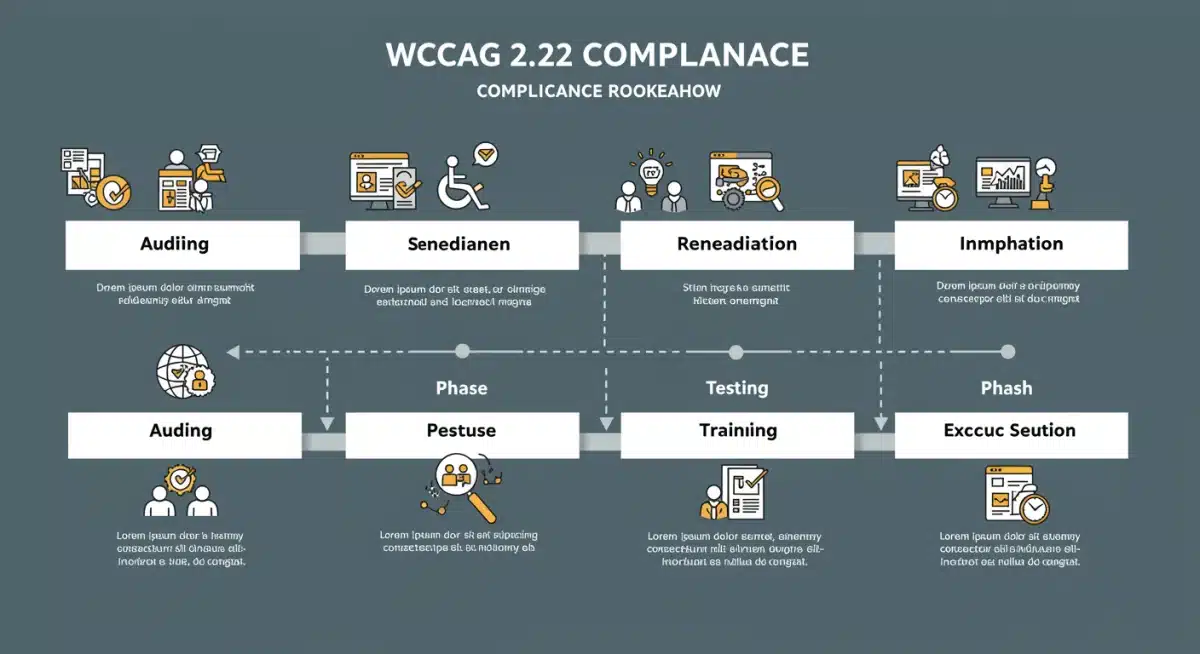
| Key Milestone | Description of Action |
|---|---|
| Months 1: Plan & Assess | Conduct initial WCAG 2.2 audit and strategic planning. |
| Months 2-3: Remediate | Implement design and code changes to fix identified issues. |
| Months 4: Test & QA | Perform comprehensive testing, including user testing with disabilities. |
| Months 5-6: Document & Monitor | Create documentation, conduct training, launch, and establish continuous monitoring. |
Frequently asked questions about WCAG 2.2 compliance
Federal accessibility standards for digital commerce refer to legal requirements, often influenced by the ADA and Section 508, ensuring online platforms are usable by individuals with disabilities. These standards aim to prevent discrimination and provide equal access to digital goods and services.
WCAG 2.2 compliance is crucial for businesses to avoid potential lawsuits, enhance brand reputation, and expand their customer base by making digital commerce accessible to everyone. It demonstrates a commitment to inclusivity and ethical business practices.
WCAG 2.2 builds upon 2.1 by introducing new success criteria, primarily focusing on improving accessibility for users with cognitive disabilities, limited dexterity, and ensuring consistent user input. This includes criteria like ‘Accessible Authentication’ and ‘Target Size’.
No, automated tools can only detect about 30-50% of WCAG issues. Full compliance requires a combination of automated scanning, manual expert review, and crucial user testing with individuals with disabilities to identify all accessibility barriers.
Non-compliance can lead to significant legal ramifications, including costly lawsuits, fines, and mandated remediation. Beyond legal penalties, businesses may suffer reputational damage, loss of customer trust, and exclusion from a large market segment.
Conclusion
Navigating the complexities of federal accessibility standards and achieving WCAG 2.2 compliance within a 6-month timeframe is an ambitious yet achievable goal for digital commerce businesses. This roadmap underscores the importance of a structured, phased approach, beginning with thorough assessment and strategic planning, progressing through meticulous remediation and comprehensive testing, and culminating in robust documentation, training, and continuous monitoring. Embracing accessibility is not merely a regulatory obligation; it’s a strategic investment in inclusivity, expanding market reach, enhancing brand reputation, and ensuring an equitable digital experience for every user. By committing to this roadmap, businesses can confidently step into a future where digital commerce is truly accessible to all.