Predictive Analytics: Cutting US Stockouts by 20% in 2025

Predictive analytics in inventory management is poised to significantly reduce stockouts for US businesses by 20% in 2025, leveraging data-driven insights to optimize supply chains and enhance operational efficiency.
Are you ready for a game-changer in how US businesses manage their stock? The rise of predictive analytics in inventory management is not just a passing trend; it’s a strategic imperative set to cut stockouts by a remarkable 20% for US businesses in 2025. This isn’t merely about preventing empty shelves; it’s about fundamentally transforming efficiency, profitability, and customer satisfaction.
The predictive power transforming inventory control
The traditional methods of inventory management, often reliant on historical data and gut feelings, are increasingly inadequate in today’s fast-paced market. Predictive analytics offers a sophisticated alternative, moving beyond simple forecasting to anticipate future demand and supply chain disruptions with remarkable accuracy. This shift empowers businesses to make proactive, data-driven decisions that minimize risks and optimize resource allocation.
By analyzing vast datasets, including sales history, seasonal trends, marketing promotions, economic indicators, and even weather patterns, predictive models can construct a far more nuanced picture of future inventory needs. This capability is crucial for US businesses operating in diverse markets, where consumer behavior can vary significantly by region and demographic.
Beyond basic forecasting: a deeper dive
Predictive analytics differentiates itself from traditional forecasting by incorporating machine learning algorithms and artificial intelligence. These advanced tools can identify complex patterns and correlations that human analysts might miss, leading to more precise and dynamic predictions. The result is a more resilient and responsive supply chain.
- Machine Learning Integration: Algorithms continuously learn from new data, improving prediction accuracy over time.
- Scenario Modeling: Businesses can simulate various future events to understand potential impacts on inventory.
- Real-time Adjustments: Systems can recommend immediate inventory adjustments based on unfolding events.
The true power lies in its ability to not just predict, but to prescribe actions. Imagine knowing not only that demand for a product will increase, but also the optimal quantity to order, when to order it, and where to store it to meet that demand perfectly. This level of insight is what makes predictive analytics a transformative force for inventory control.
Understanding the anatomy of stockouts in the US market
Stockouts are more than just an inconvenience; they represent lost sales, frustrated customers, and damaged brand reputation. In the competitive US market, where consumers have countless options, a single stockout can drive a customer to a competitor, potentially permanently. Understanding the root causes of stockouts is the first step toward effective mitigation.
Common culprits include inaccurate demand forecasts, unexpected supply chain disruptions, poor communication between departments, and inefficient inventory tracking systems. These issues are often interconnected, creating a complex web of challenges that traditional methods struggle to untangle. The financial implications can be substantial, encompassing not only direct lost revenue but also the hidden costs of expedited shipping and customer churn.
The hidden costs of empty shelves
While lost sales are the most obvious consequence, stockouts trigger a cascade of secondary costs that erode profitability. These include the cost of emergency orders, often at higher prices and with premium shipping, and the labor costs associated with managing backorders and customer complaints. Furthermore, the long-term damage to customer loyalty can be difficult to quantify but profoundly impactful.
- Lost Sales & Revenue: Direct financial loss from unfulfilled orders.
- Customer Dissatisfaction: Leads to churn and negative brand perception.
- Expedited Shipping Costs: Paying more to rush delayed inventory.
- Operational Inefficiencies: Time spent managing exceptions rather than optimizing.
By pinpointing the exact factors contributing to stockouts, predictive analytics offers a clear pathway to prevention. It moves businesses from a reactive stance, scrambling to fix problems after they occur, to a proactive one, where potential issues are identified and addressed before they impact operations or customers.
Leveraging data for demand forecasting accuracy
The cornerstone of effective inventory management is accurate demand forecasting. Predictive analytics excels in this area by integrating a multitude of data sources and employing sophisticated algorithms to generate highly reliable predictions. This goes far beyond simply looking at past sales figures; it involves understanding the intricate interplay of various factors that influence consumer behavior.
Consider a retail business. Predictive models can analyze historical sales data, promotional calendars, competitor activities, social media sentiment, and even local events to anticipate demand for specific products. For manufacturers, it might involve incorporating supplier lead times, production capacities, and raw material availability. The richer the data input, the more robust and accurate the forecast becomes.
Key data points for enhanced predictions
To achieve superior forecasting, businesses must collect and analyze diverse data points. This often requires integrating data from various internal systems, such as ERP and CRM, with external sources like market research and public economic data. The goal is to create a comprehensive data ecosystem that feeds the predictive models.
Beyond traditional metrics, incorporating unstructured data, such as customer reviews or news articles, can provide qualitative insights that further refine demand predictions. The ability to process and interpret this complex data is a hallmark of advanced predictive analytics systems.
By leveraging these rich data sets, businesses can move towards a future where inventory levels are precisely aligned with actual demand, minimizing both overstocking and understocking, and ultimately driving significant cost savings and improved customer satisfaction.
Real-world impact: US businesses cutting stockouts by 20%
The promise of predictive analytics is not just theoretical; US businesses are already demonstrating tangible results. Companies across various sectors, from retail and e-commerce to manufacturing and healthcare, are deploying these solutions to dramatically improve their inventory performance. The target of cutting stockouts by 20% in 2025 is not an arbitrary goal but a reflection of achievable improvements seen in early adopters.
For example, a major electronics retailer leveraged predictive analytics to analyze regional sales patterns, holiday shopping trends, and even competitor pricing strategies. This allowed them to pre-position high-demand items in distribution centers closer to anticipated customer hubs, reducing shipping times and virtually eliminating stockouts during peak seasons. Another case involved a food distributor using predictive models to account for perishable goods, minimizing waste while ensuring fresh products were always available.
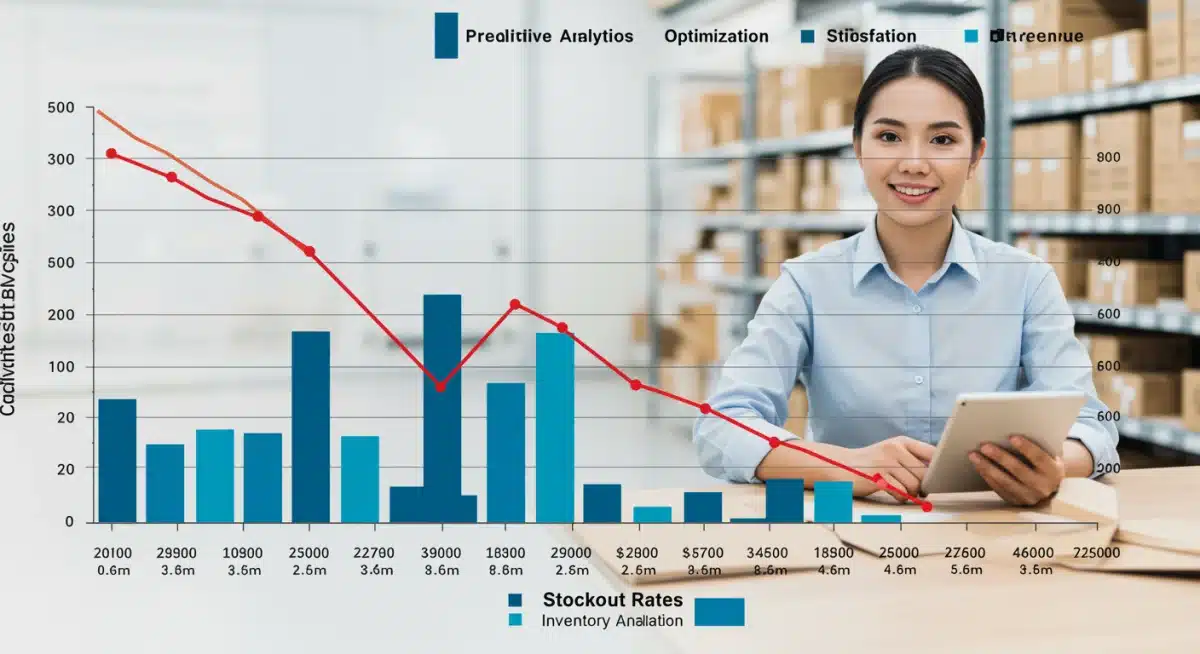

Case studies in action
The success stories are diverse, but a common thread is the commitment to data integration and continuous model refinement. Businesses that invest in robust data infrastructure and skilled analytics teams are seeing the most significant returns on their investment.
- Retail Giant: Reduced seasonal stockouts by 25% through hyper-localized demand forecasting and dynamic inventory allocation.
- Automotive Parts Supplier: Improved spare parts availability by 18%, leading to faster repair times and higher customer loyalty.
- Pharmaceutical Distributor: Optimized inventory of critical medications, ensuring consistent supply and reducing waste of expiring products.
These examples underscore that the 20% reduction in stockouts is not an ambitious dream but a realistic and achievable goal for US businesses willing to embrace the power of predictive analytics. The competitive advantage gained from such efficiency improvements is invaluable.
Implementing predictive analytics: challenges and best practices
While the benefits of predictive analytics are clear, successful implementation requires careful planning and execution. Businesses often encounter challenges such as data quality issues, resistance to new technologies, and a shortage of skilled data scientists. Addressing these hurdles proactively is essential for a smooth transition and maximum impact.
Best practices begin with a clear understanding of business objectives. What specific inventory problems are you trying to solve? Defining these goals helps in selecting the right tools and building relevant predictive models. Data governance, ensuring data accuracy, consistency, and accessibility, is another critical foundation. Without clean, reliable data, even the most sophisticated algorithms will produce flawed insights.
Overcoming common hurdles
Many organizations find that starting with a pilot program on a smaller scale can help demonstrate value and build internal support before a full-scale rollout. Investing in training for existing staff or hiring specialized talent is also crucial for long-term success.
- Data Quality: Prioritize cleaning and structuring historical data.
- Talent Gap: Invest in training or recruit data science expertise.
- Integration Issues: Ensure seamless connection with existing ERP and SCM systems.
- Change Management: Communicate benefits clearly to overcome employee resistance.
Furthermore, selecting the right technology partner and platform is vital. Look for solutions that offer scalability, robust analytical capabilities, and user-friendly interfaces. The goal is to democratize data insights, making them accessible to decision-makers across the organization, not just a select few.
The future of inventory: AI, machine learning, and continuous optimization
The journey with predictive analytics in inventory management doesn’t end with initial implementation; it’s an ongoing process of refinement and evolution. The future promises even more sophisticated applications, driven by advancements in artificial intelligence (AI) and machine learning (ML). These technologies will enable inventory systems to become increasingly autonomous, learning and adapting in real-time to dynamic market conditions.
Imagine inventory systems that can not only predict demand but also automatically place orders, negotiate with suppliers, and even reroute shipments based on unforeseen disruptions, all without human intervention. This level of automation, guided by intelligent algorithms, will free up human resources to focus on strategic planning and innovation, rather than routine operational tasks.
Emerging trends and capabilities
The integration of IoT (Internet of Things) devices, such as smart shelves and automated warehouses, will provide an even richer stream of real-time data, further enhancing the accuracy and responsiveness of predictive models. Blockchain technology could also play a role in creating more transparent and secure supply chains, improving data integrity.
- Autonomous Inventory Systems: Self-adjusting order and stocking levels.
- IoT Integration: Real-time data from smart warehouses and logistics.
- Blockchain for Transparency: Enhanced supply chain visibility and data trust.
- Hyper-Personalized Forecasting: Predicting demand at the individual customer level.
The continuous optimization loop, where models are constantly updated with new data and performance feedback, will ensure that inventory management remains at the cutting edge. For US businesses, embracing these future trends is not just about staying competitive; it’s about unlocking new levels of efficiency and resilience in an increasingly unpredictable global market.
Strategic competitive advantage for US businesses
In a global economy marked by intense competition and rapid change, achieving a 20% reduction in stockouts through predictive analytics offers a significant strategic advantage for US businesses. This isn’t merely an operational improvement; it translates directly into enhanced profitability, superior customer experiences, and a more resilient market position. Businesses that master this capability will be better equipped to navigate economic fluctuations and supply chain volatility.
The ability to consistently meet customer demand while minimizing carrying costs and waste creates a virtuous cycle. Satisfied customers become loyal advocates, driving repeat business and positive word-of-mouth. Optimized inventory levels free up capital that can be reinvested into growth initiatives, research and development, or market expansion. This strategic edge is what separates industry leaders from followers.
Beyond cost savings: market leadership
Predictive analytics enables a proactive approach to market dynamics, allowing businesses to adapt quickly to shifts in consumer preferences or unexpected events. This agility is a powerful differentiator, enabling companies to seize opportunities and mitigate threats more effectively than their less data-driven competitors.
- Enhanced Customer Loyalty: Consistent product availability builds trust.
- Improved Cash Flow: Reduced capital tied up in excess inventory.
- Market Responsiveness: Quick adaptation to demand shifts and disruptions.
- Sustainable Practices: Less waste from overstocking and obsolescence.
Ultimately, predictive analytics empowers US businesses to move beyond simply reacting to market forces and instead to shape their own future. By transforming inventory management from a cost center into a strategic asset, companies can achieve sustainable growth and cement their position as market leaders well into 2025 and beyond.
| Key Aspect | Impact on Inventory Management |
|---|---|
| Demand Forecasting | Significantly improves accuracy by analyzing diverse data points and machine learning. |
| Stockout Reduction | Aims to cut stockouts by 20% for US businesses in 2025, boosting sales and satisfaction. |
| Operational Efficiency | Optimizes inventory levels, reduces carrying costs, and minimizes waste. |
| Strategic Advantage | Provides a competitive edge through proactive decision-making and enhanced market responsiveness. |
Frequently asked questions about predictive analytics in inventory
Predictive analytics in inventory management uses historical data, statistical algorithms, and machine learning techniques to identify the likelihood of future outcomes, such as demand fluctuations or supply chain disruptions. This allows businesses to anticipate needs and optimize stock levels proactively.
By accurately forecasting demand and identifying potential supply chain issues, predictive analytics helps businesses maintain optimal inventory levels. It minimizes both overstocking and understocking, ensuring products are available when customers want them, thereby directly reducing stockouts and lost sales.
Key data includes sales history, promotional activities, seasonal trends, economic indicators, competitor data, and even weather patterns. Integrating internal ERP/CRM data with external market intelligence creates a robust foundation for accurate predictions and inventory optimization.
While large corporations often have more resources, predictive analytics solutions are becoming increasingly accessible and scalable for businesses of all sizes. Cloud-based platforms and modular tools allow smaller US businesses to adopt these technologies and reap significant benefits in inventory management.
Beyond cutting stockouts, predictive analytics leads to reduced carrying costs, less waste, improved cash flow, enhanced customer satisfaction, and a stronger competitive advantage. It transforms inventory management into a strategic asset that drives overall business growth and resilience.
Conclusion
The imperative for US businesses to embrace predictive analytics in inventory management has never been clearer. As we look towards 2025, the goal of cutting stockouts by 20% is not merely aspirational but a tangible objective achievable through strategic implementation of these advanced technologies. By transforming vast quantities of data into actionable insights, businesses can move beyond reactive stock management to a proactive, intelligent system that anticipates demand, mitigates risks, and optimizes every aspect of the supply chain. The competitive edge gained from such efficiency and foresight will be critical for sustained growth and market leadership in an increasingly dynamic commercial landscape.