Decentralized Marketplaces: Q3 2024 Impact on US E-commerce

Decentralized marketplaces are increasingly challenging traditional e-commerce giants in the US by offering enhanced transparency, reduced fees, and greater user control, fundamentally altering market dynamics over the past three months.
Over the past three months, a quiet revolution has been unfolding within the vast landscape of online commerce in the United States. The rise of decentralized marketplaces US has begun to challenge the long-held dominance of traditional e-commerce giants, prompting a closer look at their impact and potential to reshape how we buy and sell online. This emerging paradigm promises a more equitable and transparent digital economy.
Understanding decentralized marketplaces
Decentralized marketplaces represent a significant shift from the centralized models we’ve grown accustomed to. Unlike platforms such as Amazon or eBay, which act as intermediaries controlling transactions and data, decentralized alternatives operate on blockchain technology, distributing control among participants.
This fundamental difference brings about several key advantages, including enhanced security, censorship resistance, and often, lower transaction fees. For both buyers and sellers, this translates into a potentially fairer and more transparent trading environment.
The core principles of decentralization
At the heart of decentralized marketplaces lies the blockchain, a distributed ledger technology. This technology ensures that every transaction is recorded securely and transparently across a network of computers, rather than being stored on a single, vulnerable server. This inherent transparency builds trust without the need for a central authority.
- Data sovereignty: Users retain full control over their personal data.
- Censorship resistance: No single entity can delist products or ban users arbitrarily.
- Reduced fees: Eliminating intermediaries often leads to lower operational costs.
- Enhanced security: Cryptographic security protects transactions and user identities.
How they differ from traditional platforms
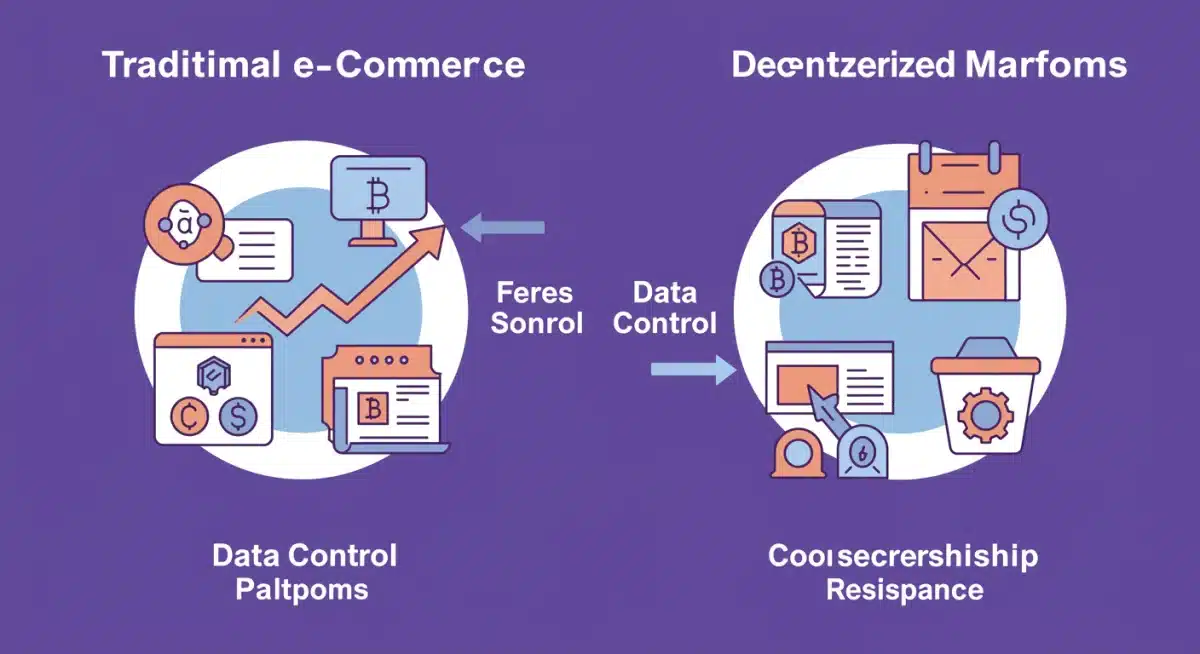
Traditional e-commerce platforms thrive on central control, offering convenience but at the cost of data privacy and often high commissions. Decentralized marketplaces, conversely, prioritize user autonomy and transparency. Over the past quarter, this distinction has started to resonate with a segment of US consumers and businesses seeking alternatives.
The operational logic is simple: smart contracts automate agreements, ensuring that funds are released only when conditions are met. This minimizes the risk of fraud and disputes, fostering a more trustless environment where participants rely on code rather than corporate policies.
In essence, understanding decentralized marketplaces means grasping a future where commerce is less about corporate gatekeepers and more about direct, secure interactions between individuals and businesses. This shift could redefine competitive landscapes and consumer expectations.
The US market: early adoption and growth trends
The past three months have shown a noticeable, albeit nascent, surge in interest and adoption of decentralized marketplaces within the US. While still a niche compared to traditional giants, the growth trajectory indicates a growing appetite for these alternative platforms among specific demographics.
This early adoption is primarily driven by tech-savvy consumers and small to medium-sized businesses (SMBs) looking for more control, lower costs, and innovative ways to engage with their customers. The US, with its strong entrepreneurial spirit and quick embrace of technology, presents fertile ground for this evolution.
Key indicators of growth in Q3 2024
Analyzing data from the third quarter of 2024 reveals several interesting trends. Transaction volumes on major decentralized platforms, while modest, have shown consistent month-over-month increases. The number of active users, particularly sellers, has also expanded as businesses seek to escape the fee structures and policy limitations of established platforms.
- Increased user registrations: A steady rise in new accounts on platforms like OpenBazaar and more specialized NFT marketplaces.
- Higher transaction frequency: Users engaging in more frequent purchases and sales.
- Diversification of goods: Beyond digital assets, physical goods and services are increasingly listed.
- Investor interest: Growing venture capital and angel investment in decentralized commerce startups.
Demographics driving adoption
The primary demographic embracing decentralized marketplaces tends to be younger, digitally native, and highly concerned with privacy and digital rights. This group is often more willing to navigate the steeper learning curve associated with blockchain technology in exchange for its perceived benefits.
Furthermore, independent creators, artists, and niche businesses are finding decentralized platforms particularly appealing. These platforms offer a direct connection to their audience, circumventing traditional gatekeepers who often take a significant cut of their earnings. This direct-to-consumer model is a powerful draw.
The US market’s early adoption patterns suggest a future where decentralized commerce plays a more significant role, catering to a segment of the population that values autonomy and transparency above all else. This growth, while gradual, is laying the groundwork for a broader impact.
Challenges and opportunities for decentralized platforms
Despite their innovative promise, decentralized marketplaces face a unique set of challenges as they strive for mainstream adoption in the US. However, these very challenges often present significant opportunities for innovation and differentiation.
The inherent complexities of blockchain technology, regulatory uncertainties, and the need for greater user education are hurdles that must be overcome. Yet, for platforms that successfully navigate these obstacles, the potential for market disruption is immense.
Navigating regulatory landscapes
One of the most significant challenges for decentralized marketplaces is the evolving and often ambiguous regulatory environment in the US. Governments and financial institutions are still grappling with how to classify and regulate digital assets and blockchain-based transactions. This uncertainty can deter potential users and investors.
However, this also creates an opportunity for platforms to proactively engage with regulators, helping to shape policies that foster innovation while protecting consumers. Clear regulatory frameworks could provide the stability needed for wider adoption.
User experience and scalability issues
For many mainstream users, the current user experience on decentralized platforms can be daunting. Setting up crypto wallets, understanding transaction fees, and navigating less intuitive interfaces can be barriers to entry. Improving UX is crucial for broader appeal.
Scalability is another technical hurdle. As transaction volumes increase, blockchain networks can become congested, leading to slower transaction times and higher fees. Innovations in layer-2 solutions and alternative consensus mechanisms are vital for ensuring these platforms can handle mass adoption.
Building trust and security
While decentralization inherently offers security benefits, the nascent nature of many platforms means that vulnerabilities can still exist, particularly in smart contract code. Building robust security protocols and fostering community trust through transparent practices are paramount.
The opportunity lies in educating users about the enhanced security features and empowering them with the tools and knowledge to protect themselves. As these platforms mature, their ability to offer truly secure and trustworthy environments will be a major differentiator.
Impact on traditional e-commerce giants
The emergence and gradual growth of decentralized marketplaces are beginning to exert a subtle yet significant pressure on traditional e-commerce giants in the US. While not an immediate threat to their dominance, the trends observed over the last three months suggest a future where these incumbents may need to adapt.
The primary impacts stem from the decentralized model’s ability to offer lower fees, greater data privacy, and censorship resistance – features that resonate with a growing segment of the market currently underserved by centralized platforms.
Fee structures and seller retention
One of the most direct impacts is on fee structures. Traditional platforms often charge substantial commissions, listing fees, and advertising costs, which can significantly eat into a seller’s profit margins. Decentralized marketplaces, with their minimal overheads, can offer much lower or even zero transaction fees.
This competitive pricing model is attracting independent sellers and small businesses who are keen to maximize their earnings. Over time, if enough sellers migrate, traditional platforms may be forced to reconsider their own fee structures to retain their vendor base, initiating a potential race to the bottom on commissions.
Data privacy and user control
Consumer concerns regarding data privacy are at an all-time high. Decentralized platforms inherently offer greater user control over personal data, as they don’t collect and monetize user information in the same way centralized entities do. This focus on privacy is a powerful differentiator.
Traditional giants, which rely heavily on data for targeted advertising and market insights, may find themselves under pressure to enhance their own privacy policies and give users more control. This could lead to new features and policy changes aimed at placating privacy-conscious consumers, even if it impacts their core business model.
Innovation and market pressure
The innovation driven by decentralized marketplaces also puts pressure on traditional players to evolve. The ability to integrate new technologies like NFTs for digital ownership verification or decentralized identity solutions could inspire traditional platforms to explore similar innovations.
While the market share of decentralized platforms remains small, their existence acts as a constant reminder that alternative, more user-centric models are viable. This competitive pressure can spur innovation within the established order, ultimately benefiting consumers across the entire e-commerce ecosystem.
In conclusion, while traditional e-commerce giants continue to dominate, the subtle ripple effects from decentralized marketplaces are undeniable. These effects, observed over the last three months, hint at a future where responsiveness to user needs and innovative business models will be key to maintaining market relevance.
Future outlook: potential for long-term disruption
Looking beyond the immediate three-month window, the long-term potential for decentralized marketplaces to disrupt e-commerce dominance in the US is considerable. While challenges remain, the foundational principles of transparency, user control, and efficiency offer a compelling vision for the future of online commerce.
The trajectory suggests a gradual but persistent chipping away at the market share of incumbents, driven by continued technological advancements and a growing societal demand for more equitable digital systems. This disruption won’t be sudden but rather a steady evolution.
Technological advancements and scalability
Ongoing developments in blockchain technology are continuously addressing key limitations such as scalability and transaction speeds. Layer-2 solutions, sharding, and more efficient consensus mechanisms are making decentralized networks faster and cheaper to use.
As these technologies mature, the user experience will invariably improve, making decentralized platforms more accessible to a broader audience. This technological evolution is crucial for moving from early adopters to mainstream consumers, paving the way for significant market penetration.
Changing consumer preferences
A fundamental shift in consumer preferences is also at play. Younger generations, in particular, are increasingly prioritizing ethical consumption, data privacy, and direct engagement with brands and creators. Decentralized marketplaces are inherently aligned with these values.
As these demographics gain more purchasing power, their choices will increasingly favor platforms that reflect their values, accelerating the adoption of decentralized commerce. This cultural shift, combined with technological readiness, creates a powerful force for disruption.
Emergence of hybrid models
It’s also plausible that the future will see the emergence of hybrid models, where traditional e-commerce platforms begin to integrate decentralized features. This could involve incorporating blockchain for supply chain transparency, NFT-based loyalty programs, or decentralized identity management.
Such a blend could offer the best of both worlds: the convenience and reach of centralized platforms with the trust and transparency of decentralization. This adaptive strategy by incumbents would acknowledge the irreversible shift towards blockchain-powered commerce.
The long-term outlook suggests that decentralized marketplaces are not a fleeting trend but a fundamental paradigm shift. Their ability to deliver on promises of fairness, transparency, and user empowerment positions them as a significant disruptive force in the US e-commerce landscape for years to come.
Case studies: prominent decentralized marketplaces in the US
To truly understand the impact of decentralized marketplaces, it’s helpful to examine some prominent examples operating within the US, and how they’ve performed over the recent three-month period. These platforms illustrate the diverse applications and growing traction of this new commerce model.
From digital collectibles to physical goods, these case studies highlight both the successes and the ongoing challenges in carving out a space against entrenched centralized competitors.
OpenBazaar: a pioneer in peer-to-peer commerce
OpenBazaar stands as a veteran in the decentralized marketplace space, offering a truly peer-to-peer shopping experience without intermediaries. Over the past quarter, it has continued to serve as a platform for a variety of goods, often appealing to users seeking privacy and freedom from censorship.
While not achieving mass-market scale, OpenBazaar’s consistent operation demonstrates the viability of a completely decentralized model. Its community-driven development and focus on user autonomy have solidified its niche, influencing newer platforms.
NFT marketplaces: the digital asset boom
Perhaps the most visible success story in decentralized commerce has been the explosion of NFT marketplaces like OpenSea, particularly relevant in the US digital art and collectibles scene. These platforms facilitate the buying and selling of unique digital assets, leveraging blockchain for verifiable ownership.
- Rapid transaction growth: Significant increase in sales volume for digital art and collectibles.
- New creator economy: Empowering artists to directly monetize their work without traditional galleries.
- Brand engagement: Major brands experimenting with NFTs for customer loyalty and engagement.
- US market dominance: Many of the largest NFT platforms and highest-value transactions originate in the US.
Emerging platforms for physical goods
Beyond digital assets, several newer platforms are attempting to apply decentralized principles to physical goods. While still in early stages, these marketplaces aim to reduce selling fees and provide greater transparency in supply chains.
These platforms often focus on niche markets, such as sustainable products or artisan crafts, where buyers are willing to pay a premium for verified authenticity and ethical sourcing. The three-month period has seen increased pilot programs and community building efforts for these types of marketplaces.
These case studies underscore that decentralized marketplaces are not a monolithic entity but a diverse ecosystem. Each platform tackles different market segments and challenges, collectively demonstrating the growing potential and varied applications of decentralized commerce in the US.
Regulatory and legal considerations
The rapid evolution of decentralized marketplaces in the US naturally brings forth a complex web of regulatory and legal considerations. Over the past three months, discussions around these issues have intensified, as policymakers and legal experts attempt to keep pace with technological innovation.
Understanding these aspects is crucial for both the operators of these platforms and the users, as they shape the environment in which decentralized commerce can thrive or face significant hurdles.
SEC and CFTC oversight
One of the primary concerns revolves around how decentralized marketplaces and the digital assets traded on them are classified by regulatory bodies like the Securities and Exchange Commission (SEC) and the Commodity Futures Trading Commission (CFTC). Depending on their structure and the nature of the assets, they could fall under securities or commodities laws.
This ambiguity creates uncertainty, potentially hindering investment and adoption. Recent statements and enforcement actions by these agencies indicate a growing focus on the crypto space, which directly impacts decentralized commerce.
Consumer protection and anti-money laundering (AML)
Ensuring consumer protection and preventing illicit activities like money laundering are paramount concerns for regulators. Decentralized platforms, by their very nature, can make it challenging to implement traditional Know Your Customer (KYC) and AML protocols.
However, innovative solutions are emerging, such as decentralized identity systems and privacy-preserving analytics, that aim to balance user anonymity with regulatory compliance. The challenge is to find a framework that supports decentralization while upholding legal obligations.
Taxation implications
The tax treatment of transactions on decentralized marketplaces is another evolving area. The IRS has provided some guidance on cryptocurrency, but specific rules for various types of decentralized commerce, especially for non-fungible tokens (NFTs) and goods, are still being clarified.
Both buyers and sellers need to be aware of their potential tax obligations, which can vary depending on the nature of the transaction and the jurisdiction. As the market grows, clearer guidance will be essential for widespread adoption and compliance.
In conclusion, the regulatory and legal landscape for decentralized marketplaces in the US is dynamic and complex. While it presents significant challenges, it also offers an opportunity for collaboration between innovators and policymakers to create a robust and secure environment for the future of decentralized commerce.
| Key Aspect | Brief Description |
|---|---|
| Growth in Q3 2024 | Steady increase in user registrations and transaction volumes, particularly for digital assets and niche physical goods. |
| Impact on E-commerce Giants | Pressure on fee structures and data privacy policies, inspiring innovation in traditional platforms. |
| Key Challenges | Regulatory uncertainty, user experience complexities, and scalability issues remain significant hurdles. |
| Future Potential | Long-term disruption driven by technological advancements, evolving consumer values, and potential hybrid models. |
Frequently asked questions
Decentralized marketplaces are online platforms built on blockchain technology that allow users to buy and sell goods or services directly, without a central intermediary. They offer enhanced transparency, censorship resistance, and often lower fees compared to traditional e-commerce sites.
They impact US e-commerce dominance by offering alternatives that challenge traditional platforms on fees, data privacy, and user control. While still nascent, their growth pressures incumbents to innovate and adapt, potentially fragmenting market share over time.
Key challenges include navigating complex regulatory landscapes, improving user experience to attract mainstream consumers, and scaling underlying blockchain technology to handle high transaction volumes efficiently and affordably.
Yes, they are generally considered secure due to blockchain’s cryptographic nature, which ensures transaction integrity and transparency. However, security can depend on smart contract robustness and user vigilance against phishing or other digital threats.
Initially focused on digital assets like NFTs and cryptocurrencies, decentralized marketplaces are expanding to include a growing variety of physical goods, services, and even real estate, catering to niche markets and independent creators.
Conclusion
The three-month snapshot into the world of decentralized marketplaces in the US reveals a dynamic and evolving landscape. While not yet poised to usurp the established e-commerce giants, these platforms are undeniably carving out a significant niche, driven by principles of transparency, user empowerment, and reduced intermediaries. Their growth trajectory, though gradual, signals a potent force for long-term disruption, compelling traditional players to re-evaluate their strategies regarding fees, data privacy, and innovation. As technology matures and user awareness increases, decentralized commerce is set to play an increasingly vital role in shaping the future of online retail, fostering a more equitable and resilient digital economy for all participants.