Embedded Finance in E-commerce: Boosting US Conversion Rates by 15%

Embedded finance in e-commerce is projected to elevate conversion rates for US merchants by 15% by 2025 through the strategic integration of payment solutions directly within the digital shopping experience.
The landscape of online retail is constantly evolving, and at its forefront is a powerful trend transforming how consumers interact with digital storefronts: embedded finance in e-commerce. This innovative approach is not merely about offering more payment options; it’s about seamlessly weaving financial services directly into the customer journey, making transactions frictionless and intuitive. For US merchants, this shift is more than just a convenience; it’s a strategic imperative projected to drive a substantial 15% increase in conversion rates by 2025, fundamentally reshaping the future of online commerce.
Understanding embedded finance in e-commerce
Embedded finance refers to the integration of financial services directly into non-financial platforms or products. In the context of e-commerce, this means that functionalities like payments, lending, insurance, and even banking services are no longer separate steps requiring redirection to external sites. Instead, they become an intrinsic part of the shopping experience, often invisible to the user.
This paradigm shift moves beyond traditional payment gateways. It encompasses a broader spectrum of financial tools designed to enhance user convenience and streamline the path to purchase. For example, a customer might apply for a loan or ‘buy now, pay later‘ (BNPL) option directly on a merchant’s product page, without ever leaving the site. This integration removes friction points, reduces cart abandonment, and ultimately leads to a more efficient and satisfying customer experience.
The evolution of digital payments
- Early e-commerce: Relied heavily on credit card inputs and external payment processors.
- Rise of digital wallets: PayPal, Apple Pay, and Google Pay offered faster, more secure checkout experiences.
- Emergence of BNPL: Services like Affirm and Klarna allowed consumers to spread costs, increasing purchasing power.
- Embedded finance: The current frontier, where financial services are native to the e-commerce platform.
The core principle behind embedded finance is to meet customers where they are, providing financial solutions precisely when and where they need them. This not only simplifies the transaction process but also builds a deeper, more trusting relationship between the merchant and the consumer. By offering tailored financial products, merchants can better serve diverse customer needs, from budget-conscious shoppers to those seeking more flexible payment terms.
Ultimately, embedded finance is about creating an ecosystem where financial services are not just an add-on, but a fundamental component of the overall e-commerce value proposition. This integrated approach promises to unlock new revenue streams for merchants and provide unparalleled convenience for consumers, setting the stage for significant growth in conversion rates.
The impact on US merchant conversion rates
The direct correlation between embedded finance and increased conversion rates for US merchants is becoming increasingly clear. When financial services are seamlessly integrated into the e-commerce journey, the path from browsing to purchase is significantly shortened and simplified. This reduction in friction is a critical factor in preventing cart abandonment, a persistent challenge for online retailers.
Consider a scenario where a customer is ready to make a significant purchase but lacks immediate funds. With embedded lending or BNPL options available directly on the product page, they can instantly assess their eligibility, apply, and complete the purchase without leaving the site. This immediate gratification and removal of financial barriers directly translate into higher conversion rates. Data consistently shows that offering flexible payment options can boost sales by double-digit percentages, and embedded finance takes this to the next level by making these options native to the shopping cart.
Key drivers of conversion rate improvement
- Reduced friction: Fewer steps in the checkout process mean fewer opportunities for customers to abandon their carts.
- Increased purchasing power: BNPL and embedded lending allow customers to afford higher-value items.
- Enhanced customer experience: A smooth, integrated process leads to greater satisfaction and repeat business.
- Personalized offers: Merchants can leverage data to offer relevant financial products at the point of need.
Beyond direct sales, embedded finance also fosters greater customer loyalty. When a merchant provides a hassle-free and financially flexible shopping experience, customers are more likely to return. This creates a virtuous cycle where convenience drives conversions, which in turn builds loyalty and further increases future sales. For US merchants navigating an increasingly competitive digital marketplace, this ability to differentiate through superior financial integration is a powerful tool.
The projected 15% increase in conversion rates by 2025 is not an optimistic forecast but a realistic outcome driven by tangible benefits. As more merchants adopt these integrated solutions, the standard for online shopping will rise, making embedded finance a crucial element for sustained growth and competitiveness.
Integrating payment solutions: practical strategies
For US merchants looking to capitalize on the benefits of embedded finance, the strategic integration of payment solutions is paramount. This involves more than just adding a new payment button; it requires a thoughtful approach to selecting and implementing financial technologies that align with both business objectives and customer needs. The goal is to make the payment process so intuitive that it almost disappears into the background of the shopping experience.
One of the first practical strategies is to partner with fintech providers specializing in embedded finance. These providers offer APIs and SDKs that allow merchants to easily integrate various financial services, from BNPL options to loyalty-driven micro-loans, directly into their e-commerce platforms. This partnership approach enables merchants to leverage expert financial technology without having to build these complex systems from scratch.
Selecting the right embedded finance partners
- Assess compatibility: Ensure the solution integrates smoothly with your existing e-commerce platform.
- Evaluate customer experience: Prioritize solutions that offer a truly seamless and intuitive user journey.
- Consider data security: Partner with providers who meet rigorous security and compliance standards.
- Analyze cost structures: Understand transaction fees, integration costs, and potential revenue share models.
Another crucial strategy involves data analytics. By understanding customer purchasing patterns, preferences, and financial behaviors, merchants can offer personalized embedded financial products. For instance, a customer who frequently buys high-value electronics might be pre-approved for an installment plan, while a regular shopper of everyday goods might receive tailored credit offers. This data-driven personalization not only enhances the customer experience but also optimizes the effectiveness of embedded financial offerings.
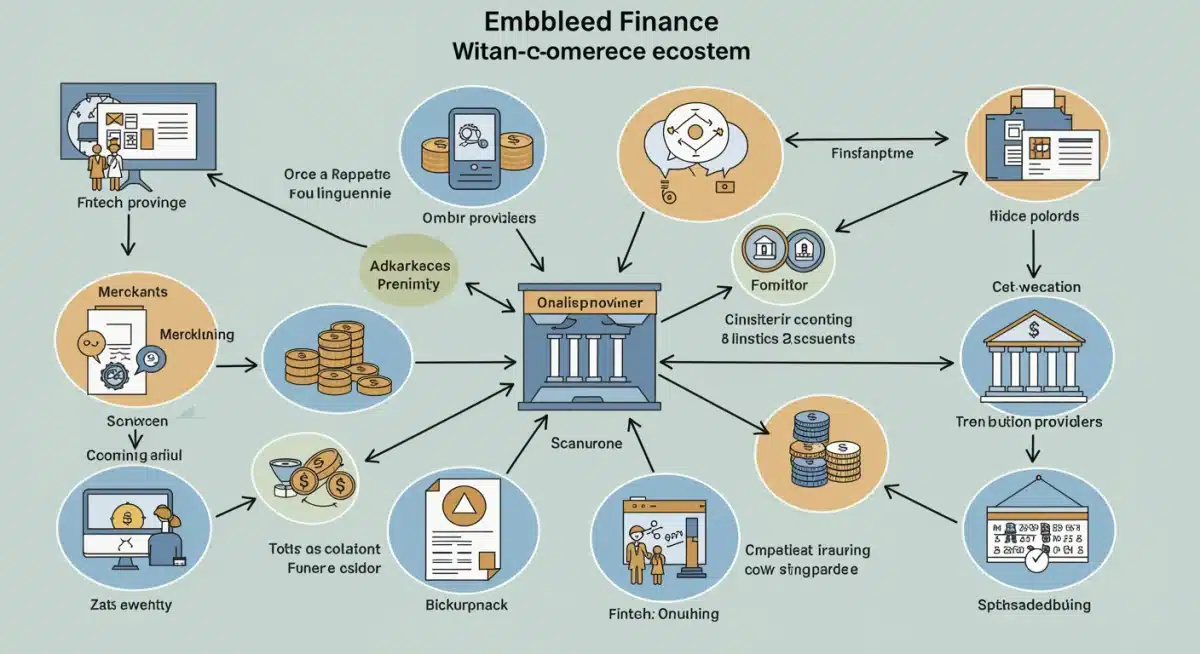
Furthermore, merchants should focus on transparent communication regarding embedded financial products. While the goal is seamless integration, customers need to understand the terms and conditions of any credit or payment plan they engage with. Clear, concise explanations at the point of offer build trust and prevent potential misunderstandings, reinforcing the positive impact of embedded finance on the customer relationship. Effective integration is a continuous process of refinement, adapting to both technological advancements and evolving consumer expectations.
Challenges and considerations for adoption
While the promise of embedded finance in e-commerce is significant, its widespread adoption by US merchants is not without challenges. Navigating the complex landscape of financial regulations, ensuring robust data security, and managing the technical complexities of integration are critical considerations that require careful planning and execution. Merchants must approach embedded finance with a clear understanding of these hurdles to unlock its full potential.
Regulatory compliance is perhaps the most significant challenge. Financial services are heavily regulated, and integrating lending, insurance, or banking services means merchants must adhere to various federal and state laws. This includes consumer protection laws, data privacy regulations (like CCPA), and anti-money laundering (AML) guidelines. Merchants need to ensure their embedded finance partners are fully compliant and that their own operations align with these legal frameworks to avoid penalties and maintain consumer trust.
Overcoming adoption hurdles
- Regulatory navigation: Partner with legal and compliance experts experienced in fintech.
- Data security: Implement robust encryption, multi-factor authentication, and fraud detection systems.
- Technical integration: Utilize API-first solutions and work with experienced development teams or partners.
- Customer trust: Be transparent about financial product terms and data usage.
Data security and privacy are also paramount. Embedded finance involves handling sensitive financial and personal information, making merchants prime targets for cyberattacks. Robust security infrastructure, including advanced encryption, fraud detection systems, and regular security audits, is essential. Building and maintaining customer trust hinges on demonstrating a commitment to protecting their data. A single security breach can severely damage a merchant’s reputation and negate any gains from increased conversion rates.
Finally, the technical integration itself can be complex. While many fintech providers offer user-friendly APIs, customizing these solutions to fit a merchant’s unique e-commerce platform and existing workflows requires technical expertise. Merchants may need to invest in skilled development teams or engage specialized integration partners to ensure a smooth and efficient implementation. Addressing these challenges head-on will be crucial for US merchants aiming to successfully leverage embedded finance to drive a 15% increase in conversion rates by 2025.
Future trends and market growth in the US
The trajectory for embedded finance in e-commerce within the US market indicates robust growth and continuous innovation. Looking towards 2025 and beyond, several key trends are set to shape how merchants and consumers interact with integrated financial services. These trends suggest a future where financial transactions are not just seamless but also highly personalized and predictive, further cementing embedded finance as a cornerstone of modern e-commerce.
One significant trend is the expansion of embedded insurance. Beyond traditional product warranties, e-commerce platforms will increasingly offer highly customized insurance products at the point of sale, tailored to the specific item being purchased or the customer’s profile. For example, travel sites might offer trip cancellation insurance as a native option during booking, making the process effortless for the consumer and adding value for the merchant. This personalization enhances customer peace of mind and creates new revenue streams.
Emerging trends in embedded finance
- AI-driven personalization: Leveraging artificial intelligence to offer highly relevant financial products.
- Micro-lending and micro-investing: Smaller, more flexible financial services integrated into daily transactions.
- Subscription-based financial services: Bundling financial tools with core e-commerce offerings.
- Open banking integration: Greater connectivity between financial institutions and e-commerce platforms.
Another powerful trend is the increasing role of artificial intelligence (AI) in personalizing embedded financial offerings. AI algorithms can analyze vast amounts of customer data to predict financial needs and offer proactive solutions. Imagine an e-commerce platform suggesting a flexible payment plan for a high-value item based on your spending history, even before you consider it. This predictive capability moves beyond reactive offerings to truly anticipate and fulfill customer financial requirements, leading to even higher conversion rates.
The growth of open banking initiatives in the US will also play a pivotal role. As consumers gain greater control over their financial data and consent to share it with trusted third parties, e-commerce platforms can access a richer understanding of their customers’ financial health. This access will enable even more sophisticated and responsible embedded financial products, further blurring the lines between commerce and finance. The market is evolving rapidly, and staying ahead of these trends will be key for US merchants aiming for that 15% conversion rate increase.
Maximizing value: strategies for merchants
To truly maximize the value derived from embedded finance, US merchants must adopt a comprehensive strategy that goes beyond mere implementation. It involves a continuous cycle of optimization, customer feedback integration, and strategic partnerships designed to refine and expand their integrated financial offerings. The goal is not just to increase conversion rates, but to build a more robust, customer-centric business model.
A crucial strategy is to continuously monitor and analyze the performance of embedded financial products. This includes tracking take-up rates, conversion rate uplift, average order value (AOV), and customer satisfaction. By understanding which offerings resonate most with their audience and which areas need improvement, merchants can make data-driven decisions to optimize their embedded finance strategy. A/B testing different financial product placements or messaging can also yield valuable insights.
Optimizing embedded finance for maximum impact
- Continuous data analysis: Regularly review performance metrics of integrated financial services.
- Iterative product development: Refine offerings based on customer feedback and market trends.
- Cross-functional collaboration: Ensure finance, marketing, and tech teams work together seamlessly.
- Educate customers: Clearly communicate the benefits and terms of embedded financial products.
Furthermore, merchants should actively seek and incorporate customer feedback. Surveys, reviews, and direct interactions can provide invaluable insights into how consumers perceive and utilize embedded financial services. Understanding their pain points or unmet needs can lead to the development of new, highly relevant offerings that further enhance the shopping experience and drive conversions. This customer-centric approach is vital for long-term success.
Finally, fostering strong, collaborative relationships with embedded finance providers is essential. These partnerships should extend beyond initial integration to include ongoing support, joint innovation, and shared strategic planning. By working closely with their fintech partners, merchants can stay abreast of new technologies, regulatory changes, and emerging market opportunities, ensuring their embedded finance strategy remains cutting-edge and effective. Maximizing value from embedded finance is an ongoing journey that requires dedication, foresight, and a commitment to innovation.
| Key Aspect | Brief Description |
|---|---|
| Increased Conversion | Seamless integration of financial services reduces friction, boosting purchases by an estimated 15%. |
| Enhanced Customer Experience | Personalized payment options and financial tools lead to greater satisfaction and loyalty. |
| Strategic Integration | Merchants must partner with fintechs and leverage data for effective, secure implementation. |
| Future Growth | AI, micro-lending, and open banking will drive further innovation and market expansion. |
Frequently asked questions about embedded finance
Embedded finance in e-commerce refers to the seamless integration of financial services, such as payment options, lending, or insurance, directly into an online shopping platform. This means customers can access these services without leaving the merchant’s website, streamlining the purchase process and enhancing convenience.
By integrating financial services directly into the customer journey, embedded finance reduces friction points, simplifies the checkout process, and offers flexible payment solutions like ‘buy now, pay later’ (BNPL). This empowers customers to complete purchases more easily, especially for higher-value items, directly leading to higher conversion rates.
For US merchants, the main benefits include a projected 15% increase in conversion rates, reduced cart abandonment, enhanced customer satisfaction and loyalty, and the ability to offer personalized financial products. It also opens new revenue streams and provides a competitive edge in a crowded market.
Merchants must navigate regulatory compliance, ensure robust data security and privacy, and manage the technical complexities of integration. Partnering with experienced fintech providers and legal experts is crucial to address these challenges effectively and maintain consumer trust.
Future trends include AI-driven personalization of financial products, the expansion of embedded insurance, growth in micro-lending and micro-investing, and increased integration facilitated by open banking initiatives. These innovations will make financial services even more seamless and tailored to individual customer needs.
Conclusion
The journey towards a 15% increase in conversion rates for US merchants by 2025 through embedded finance in e-commerce is not just a possibility, but a tangible trajectory. By seamlessly weaving financial services into the very fabric of the online shopping experience, merchants can eliminate friction, enhance customer satisfaction, and unlock unprecedented growth. While challenges related to regulation and security exist, strategic partnerships and a commitment to customer-centric innovation will pave the way for a more integrated, efficient, and profitable digital marketplace. Embracing embedded finance is no longer an option but an imperative for any US merchant aiming to thrive in the evolving landscape of online retail.