AR in Shopping: Boosting US Online Purchases by 10% in 2025

Augmented Reality (AR) is poised to significantly enhance customer confidence in online shopping, projecting a 10% increase in US online purchases by 2025 by bridging the gap between digital and physical retail experiences.
The landscape of online shopping is undergoing a profound transformation, with technologies like augmented reality at its forefront. By 2025, Augmented Reality (AR) in Shopping: Boosting Customer Confidence by 10% for US Online Purchases in 2025 is not just a prediction but a tangible goal, fundamentally reshaping how consumers interact with products before making a purchase.
The transformative power of AR in retail
Augmented Reality (AR) is rapidly moving from a niche technology to a mainstream tool, especially within the retail sector. It overlays digital information and objects onto the real world, allowing consumers to visualize products in their own environment before committing to a purchase. This capability is proving to be a game-changer for customer confidence and, consequently, online sales.
The core appeal of AR in shopping lies in its ability to mitigate the uncertainties associated with online purchases. Shoppers can often hesitate due to doubts about how an item will look, fit, or function in their personal space. AR directly addresses these concerns, providing a virtual ‘try-before-you-buy’ experience that was once only possible in physical stores.
Bridging the physical-digital divide
One of the most significant challenges for online retailers has always been the inability to offer a physical interaction with products. AR technology effectively bridges this gap, creating a more immersive and informative shopping journey. This digital bridge is not merely about novelty; it’s about practical utility and enhancing decision-making.
- Enhanced visualization: AR allows customers to see products in 3D, from all angles, and in their intended environment.
- Improved fit and scale: Whether it’s furniture in a living room or clothing on a body, AR provides accurate sizing and proportion.
- Reduced returns: Better visualization leads to more informed purchases, significantly lowering return rates for retailers.
Ultimately, AR’s power in retail stems from its capacity to empower consumers with more information and a clearer understanding of their potential purchases. This increased clarity directly translates into greater confidence, which is a critical driver for higher conversion rates and customer satisfaction in the online sphere.
Enhancing customer confidence through virtual try-ons
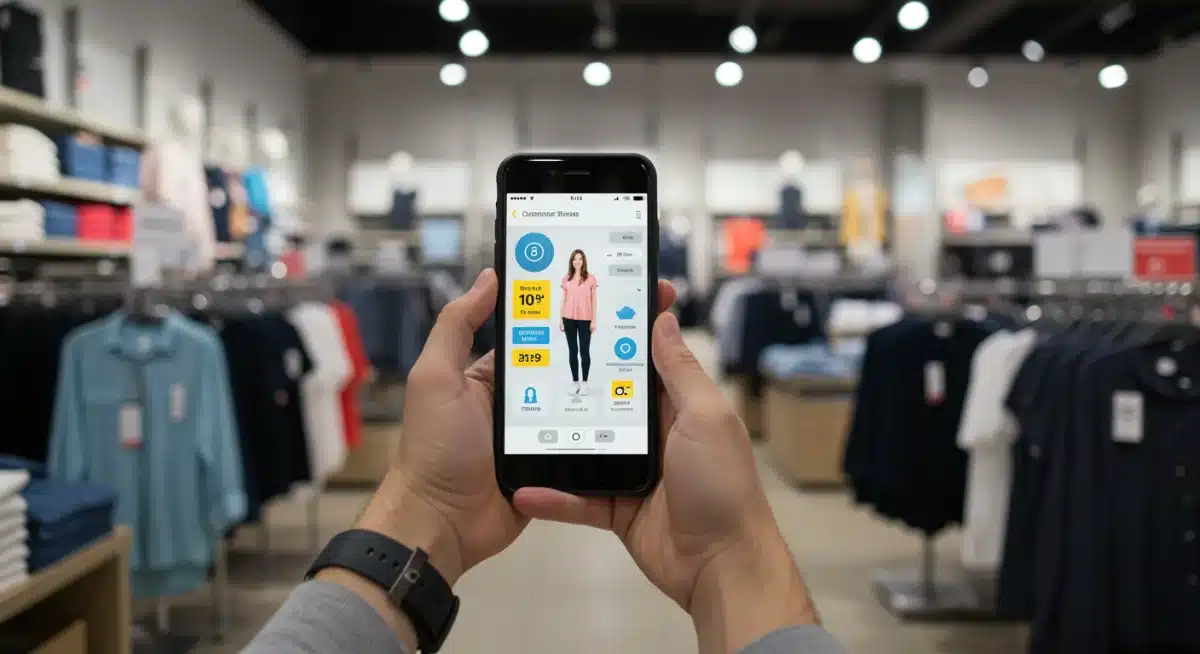
One of the most impactful applications of AR in shopping is the virtual try-on experience, particularly prevalent in the fashion, beauty, and eyewear industries. This feature allows customers to virtually ‘wear’ items, see how they look on their own body or face, and experiment with different styles without any physical interaction.
For fashion retailers, virtual try-on addresses a major pain point: the uncertainty of fit and appearance. Customers can often be hesitant to buy clothes or accessories online without knowing how they will flatter their physique or personal style. AR technology provides a realistic simulation, allowing shoppers to visualize garments, jewelry, or even shoes on a digital representation of themselves or directly overlaid onto their live camera feed.
Real-world impact on purchase decisions
The ability to virtually try on products has a direct and measurable impact on consumer behavior. It transforms a speculative purchase into a confident decision, as shoppers gain a much clearer understanding of the product’s suitability. This not only boosts the likelihood of a purchase but also fosters a stronger sense of satisfaction post-purchase.
- Fashion: Customers can try on clothes, hats, and accessories virtually, seeing how they drape and fit their body type.
- Beauty: AR apps allow users to experiment with different makeup shades, hairstyles, and cosmetic products on their own face.
- Eyewear: Shoppers can virtually try on various frames, observing how different styles complement their facial features.
By offering this level of personalized interaction, retailers are not just selling products; they are selling certainty and a personalized experience. This direct engagement with the product, even if virtual, significantly reduces the cognitive distance between browsing and buying, making the purchase decision feel more assured and less risky for the consumer.
AR’s role in home decor and furniture retail
The home decor and furniture sectors are prime beneficiaries of Augmented Reality, as these categories often involve significant investment and a strong need for spatial visualization. AR applications allow customers to virtually place furniture, artwork, and decorative items into their actual living spaces, providing an unparalleled preview of how these products will look and fit.
Before AR, buying a sofa or a dining table online was fraught with guesswork about size, color, and how it would integrate with existing decor. Customers would often rely on measurements and imagination, leading to frequent returns and dissatisfaction. AR eliminates much of this uncertainty, projecting 3D models of products into the user’s home environment via their smartphone or tablet camera.
Visualizing products in personal spaces
This capability is particularly powerful for large, expensive items where a mistake can be costly and inconvenient. Seeing a virtual couch in one’s living room, scaled correctly and viewed from different angles, provides a level of detail and assurance that product photos alone cannot match. It helps consumers make confident decisions by literally seeing the future arrangement.
- Furniture placement: Visualize chairs, tables, and sofas in your room, checking dimensions and style.
- Decor integration: See how rugs, lamps, and wall art complement your existing interior design.
- Color and texture matching: Get a better sense of how different finishes and fabrics will appear in your home’s lighting.
The adoption of AR in these segments is not just a trend; it’s a fundamental shift in how consumers approach home furnishing purchases. It empowers them with the tools to design their spaces virtually, fostering a deeper connection with the products and significantly boosting their confidence in making the right choice the first time.
The impact on reducing product returns
One of the most significant financial and logistical burdens for online retailers is the high rate of product returns. When customers purchase items online without the ability to physically inspect them, there’s always a risk that the product won’t meet their expectations regarding size, color, fit, or overall appearance. Augmented Reality presents a powerful solution to this pervasive problem.
By providing a more accurate and immersive preview of products, AR helps align customer expectations with the actual item. When a customer uses AR to visualize a product in their environment or try it on virtually, they gain a much clearer understanding of what they are buying. This clarity drastically reduces the chances of disappointment upon delivery, which is a primary cause of returns.
Data-driven insights and customer satisfaction
Retailers employing AR solutions have reported noticeable decreases in return rates across various product categories. This not only saves businesses significant costs associated with reverse logistics, restocking, and potential damages but also contributes positively to environmental sustainability by reducing unnecessary shipping.
- Accurate sizing: AR helps customers confirm the dimensions of a product, preventing purchases that are too big or too small.
- Color and texture fidelity: Virtual representations allow for a better assessment of how colors and materials appear in different lighting conditions.
- Fit for purpose: Shoppers can ensure the product meets their specific needs and integrates seamlessly into their intended use.
Ultimately, a reduction in returns signifies a higher level of customer satisfaction. When customers receive exactly what they expected, their trust in the retailer grows, leading to repeat business and positive word-of-mouth. AR, therefore, serves as a crucial tool for operational efficiency and long-term customer loyalty.
Future trends: hyper-personalization and immersive experiences
Looking beyond the immediate benefits, Augmented Reality is set to drive even more sophisticated and personalized shopping experiences in the coming years. The trajectory of AR technology points towards a future where online shopping transcends simple transactions, becoming deeply integrated with individual preferences and real-world contexts. Hyper-personalization, powered by advanced AR, is the next frontier.
Imagine walking through a virtual mall tailored entirely to your style, where every item displayed has been curated based on your past purchases, browsing history, and even your current mood. AR will enable this by combining real-time data with immersive visuals, creating a truly unique and engaging journey for each shopper. This level of customization goes far beyond current recommendation engines.
The evolution of AR in retail
The future of AR in retail will also see a blurring of lines between online and offline shopping. Smart mirrors in physical stores will offer AR try-ons, while mobile AR will continue to enhance at-home experiences. Wearable AR devices, such as smart glasses, could eventually replace smartphones as the primary interface for augmented shopping, offering hands-free, always-on immersive interactions.
- Personalized virtual spaces: Create bespoke shopping environments that reflect individual tastes and needs.
- AI-driven recommendations: AR combined with AI will suggest products based on real-time environmental factors and personal style analysis.
- Interactive storytelling: Brands will use AR to tell richer, more engaging stories about their products, enhancing emotional connection.
These advancements promise to make online shopping not just more convenient, but also more exciting and emotionally resonant. As AR technology matures and becomes more accessible, it will continue to redefine consumer expectations, setting new benchmarks for engagement, personalization, and ultimately, purchase confidence in the digital marketplace.
The economic impact: a 10% boost for US online purchases
The projected 10% increase in US online purchases by 2025, largely attributed to the widespread adoption of Augmented Reality, signifies a substantial economic shift. This growth isn’t merely incremental; it represents a fundamental change in consumer behavior and market dynamics. The enhanced confidence instilled by AR directly translates into higher conversion rates, larger average order values, and reduced cart abandonment.
For the vast US e-commerce market, a 10% boost translates into billions of dollars in additional revenue. This growth is driven by several factors, including the expanded reach of online retail to previously hesitant demographics, the increased willingness of consumers to purchase higher-value items online, and the overall improved efficiency of the digital shopping funnel.
Driving market growth and competitive advantage
Retailers who embrace AR early are likely to gain a significant competitive advantage, attracting a tech-savvy customer base and fostering stronger brand loyalty. The investment in AR technology is increasingly viewed not just as an expense, but as a strategic imperative for market differentiation and sustained growth.
- Increased conversion rates: Customers are more likely to complete a purchase when they feel confident about their choice.
- Higher average order value: AR encourages the purchase of more expensive items by reducing perceived risk.
- Broader customer base: AR makes online shopping more appealing to consumers who prefer a tactile or visual experience.
The economic ripple effect extends beyond direct sales. It stimulates innovation in logistics, payment systems, and digital marketing, creating a more robust and dynamic e-commerce ecosystem. The 10% confidence boost projected for US online purchases by 2025 underscores AR’s critical role as a market disruptor and a key driver of future retail prosperity.
Challenges and considerations for AR adoption
While the benefits of Augmented Reality in shopping are clear and compelling, its widespread adoption is not without challenges. Retailers and technology providers must navigate several hurdles to fully realize AR’s potential and ensure a seamless, positive experience for consumers. Addressing these considerations is crucial for the projected 10% boost in US online purchases by 2025 to materialize effectively.
One primary challenge is the technical sophistication required to develop and implement high-quality AR experiences. Creating realistic 3D models of products, ensuring accurate scaling, and integrating AR seamlessly into existing e-commerce platforms demands significant investment in talent and infrastructure. Not all retailers, especially smaller businesses, may have the resources to deploy sophisticated AR solutions.
Overcoming adoption barriers
Another key consideration is user accessibility and performance. While most modern smartphones support AR, older devices might struggle, leading to a fragmented user experience. Furthermore, ensuring that AR applications are intuitive and easy to use for all demographics is vital. A clunky or unreliable AR experience can deter users rather than enhance their confidence.
- Cost of development: High initial investment for 3D modeling, software integration, and maintenance.
- Technical proficiency: Need for skilled developers and designers to create compelling AR content.
- Device compatibility: Ensuring the AR experience works across a wide range of devices and operating systems.
- User experience design: Creating intuitive interfaces that make AR accessible and enjoyable for all shoppers.
Overcoming these challenges will involve continued innovation in AR development tools, standardization of formats, and a focus on user-centric design. Collaborations between tech companies and retailers will be essential to lower barriers to entry and ensure that AR becomes a ubiquitous and reliable part of the online shopping experience, solidifying its role in boosting consumer confidence.
| Key Aspect | Description |
|---|---|
| Confidence Boost | AR helps customers visualize products accurately, reducing purchase uncertainty. |
| Reduced Returns | Better informed decisions lead to fewer product returns and higher satisfaction. |
| Market Growth | Projected 10% increase in US online purchases by 2025 due to AR adoption. |
| Key Applications | Virtual try-ons for fashion/beauty, home decor visualization. |
Frequently asked questions about AR in shopping
AR in online shopping overlays digital content onto the real world via a device’s camera. It allows customers to visualize products, like furniture in their home or clothes on their body, before making a purchase, enhancing product understanding.
AR boosts confidence by providing a realistic preview of products. Customers can assess size, fit, and appearance in their own environment, reducing uncertainty and the fear of receiving an item that doesn’t meet expectations, leading to more assured decisions.
Industries like home decor, furniture, fashion, and beauty significantly benefit. AR’s virtual try-on and visualization capabilities are particularly impactful for items where physical interaction or spatial understanding is crucial for the purchase decision.
Yes, AR is expected to significantly reduce return rates. By enabling customers to make more informed purchasing decisions through accurate visualization, the likelihood of dissatisfaction and subsequent returns is considerably lowered, benefiting both consumers and retailers.
By 2025, Augmented Reality is projected to boost US online purchases by 10%. This increase is driven by enhanced customer confidence, leading to higher conversion rates and a broader appeal for online shopping across various product categories and demographics.
Conclusion
The integration of Augmented Reality into the online shopping experience is not merely an technological upgrade; it represents a fundamental shift in how consumers interact with products and make purchasing decisions. The projected 10% increase in US online purchases by 2025, fueled by enhanced customer confidence, underscores AR’s pivotal role in shaping the future of retail. As the technology continues to evolve and become more accessible, its capacity to bridge the physical-digital divide will only grow, delivering more personalized, immersive, and ultimately, more trustworthy shopping journeys for consumers nationwide.