Hyper-Personalization with Data: Boosting US Customer Lifetime Value 22% by 2025

Hyper-personalization, driven by advanced data analytics, is set to revolutionize how US brands engage with customers, projecting a 22% increase in customer lifetime value by 2025 through tailored experiences.
In the rapidly evolving landscape of consumer engagement, the ability to connect with customers on a deeply individual level has become the ultimate differentiator. By 2025, US brands embracing hyper-personalization with data are projected to achieve a significant 22% higher customer lifetime value, fundamentally reshaping market strategies and consumer expectations.
The imperative of hyper-personalization in today’s market
The modern consumer journey is no longer linear; it is a complex tapestry woven from countless digital and physical touchpoints. Brands that can not only track but also intelligently interpret this data stand to gain a considerable competitive advantage.
Hyper-personalization moves beyond basic segmentation, utilizing real-time data to deliver highly relevant content, products, and services at the precise moment they are most impactful. This approach fosters a deeper connection, transforming transient interest into enduring loyalty.
Understanding the shift from personalization to hyper-personalization
While personalization involves segmenting customers into groups and tailoring experiences, hyper-personalization takes this a step further. It focuses on the individual, leveraging artificial intelligence and machine learning to analyze vast datasets and predict specific needs and preferences.
- Granular data analysis: Moving beyond demographics to individual behaviors.
- Real-time adaptation: Adjusting offers and communications instantly based on current actions.
- Predictive modeling: Anticipating future needs and proactively addressing them.
- Contextual relevance: Delivering the right message, at the right time, on the right channel.
This nuanced understanding allows brands to anticipate customer needs, offering solutions before they are even explicitly sought. The outcome is an experience that feels intuitive and highly valued by the customer, leading directly to increased engagement and satisfaction.
The transition to hyper-personalization is not merely a technological upgrade; it represents a fundamental shift in how brands perceive and interact with their customer base. It requires a commitment to data-driven decision-making and a customer-centric philosophy at every level of the organization.
Leveraging data for deeper customer insights
The foundation of effective hyper-personalization lies in the quality and breadth of data collected. US brands are increasingly investing in sophisticated data analytics platforms to consolidate information from various sources, paint a comprehensive picture of each customer.
This consolidated view enables businesses to move past superficial interactions, understanding the underlying motivations and preferences that drive consumer behavior. The richer the data, the more precise and effective the hyper-personalized strategies become.
Key data sources for hyper-personalization
A multi-faceted approach to data collection is essential. Brands must integrate information from every touchpoint, both online and offline, to build truly robust customer profiles.
- Behavioral data: Website clicks, purchase history, app usage, content consumption.
- Transactional data: Purchase frequency, average order value, product categories.
- Demographic data: Age, location, income (used as a foundational layer).
- Preference data: Explicit choices, wish lists, survey responses.
- Contextual data: Device used, time of day, current location.
By combining these diverse data streams, brands can create dynamic customer profiles that evolve with each interaction. This continuous learning process ensures that personalized experiences remain relevant and compelling over time.
The challenge, however, lies not just in collecting data but in making it actionable. Brands need robust analytics capabilities to extract meaningful insights and translate them into tangible strategies. This often involves employing AI and machine learning algorithms to identify patterns and predict future behaviors that humans alone might miss.
Strategies for enhancing customer lifetime value
Achieving a 22% higher customer lifetime value (CLV) by 2025 for US brands through hyper-personalization requires a strategic, multi-pronged approach. It’s about designing experiences that resonate deeply, fostering loyalty and encouraging repeat business.
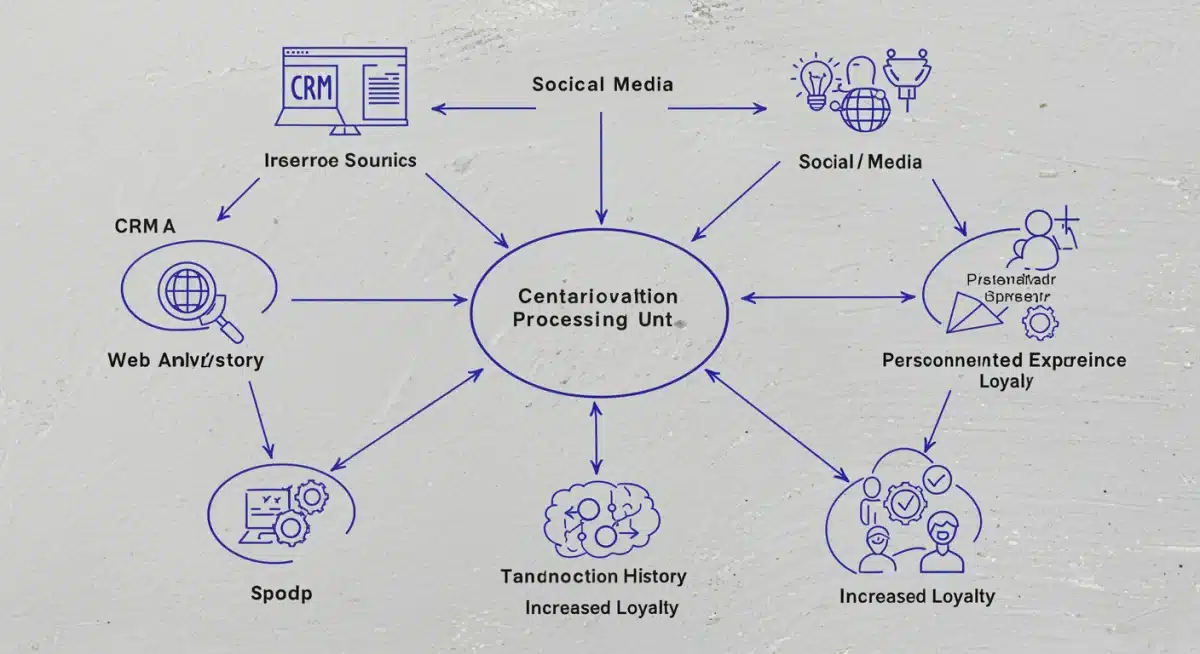
From initial acquisition to post-purchase support, every stage of the customer journey presents an opportunity for hyper-personalization to drive value. Brands must identify these critical touchpoints and infuse them with tailored interactions.
Implementing personalized customer journeys
Mapping out the customer journey and identifying key moments for personalized intervention is crucial. This involves understanding where customers might drop off, what information they seek, and how they prefer to interact.
For example, a customer browsing hiking gear might receive personalized recommendations for complementary products like water bottles or trail snacks, alongside content about local hiking trails. This proactive approach enhances the shopping experience and demonstrates a deep understanding of their interests.
- Personalized product recommendations: Based on past purchases, browsing history, and similar customer profiles.
- Tailored content delivery: Sending relevant articles, videos, or guides that align with customer interests.
- Dynamic pricing and offers: Presenting discounts or bundles that are most appealing to individual customers.
- Proactive customer service: Using data to anticipate issues and offer support before a customer even contacts them.
These strategies, when executed effectively, create a seamless and highly relevant experience that strengthens the customer-brand relationship. The perceived value of the brand increases, leading to greater spend and longer retention.
Ultimately, enhancing CLV through hyper-personalization is about building trust and demonstrating that the brand genuinely understands and values its customers as individuals. This sustained effort cultivates a loyal customer base that not only returns but also advocates for the brand.
The role of AI and machine learning in hyper-personalization
Artificial intelligence (AI) and machine learning (ML) are not just buzzwords; they are the technological backbone enabling hyper-personalization at scale. These advanced technologies process vast amounts of customer data, identify complex patterns, and make real-time predictions that would be impossible for human analysts alone.
For US brands aiming for that 22% CLV increase, integrating AI and ML into their marketing and customer relations strategies is non-negotiable. These tools transform raw data into actionable insights, driving more effective and efficient personalized campaigns.
How AI and ML power personalized experiences
AI algorithms excel at pattern recognition, making them ideal for sifting through customer data to find subtle correlations and predict future behaviors. ML models continuously learn and improve, ensuring that personalized recommendations become more accurate over time.
- Predictive analytics: Foreseeing customer churn, next best actions, or product preferences.
- Automated content generation: Creating personalized email subject lines or ad copy at scale.
- Chatbots and virtual assistants: Providing instant, personalized support and recommendations.
- Sentiment analysis: Understanding customer emotions from text data to tailor interactions.
These capabilities allow brands to automate the delivery of highly relevant messages and offers, ensuring that every interaction is optimized for impact. The efficiency gained frees up human teams to focus on more complex strategic initiatives and exceptional customer service.
The continuous feedback loop inherent in ML models means that hyper-personalization strategies are always improving. As customers interact with personalized content, the models learn from their responses, refining future recommendations and deepening the level of personalization, which directly contributes to higher CLV.
Overcoming challenges in hyper-personalization implementation
While the benefits of hyper-personalization are clear, its implementation is not without hurdles. US brands must navigate complexities related to data privacy, technological integration, and organizational change to fully realize its potential.
Addressing these challenges proactively is critical for successful deployment and for building customer trust. A well-planned approach can mitigate risks and ensure that hyper-personalization initiatives deliver on their promise of increased CLV.
Common obstacles and solutions
One of the primary concerns is data privacy. Consumers are increasingly aware of how their data is used, and brands must be transparent and compliant with regulations like CCPA and future data protection laws.
- Data privacy concerns: Implement robust security measures and clear consent policies.
- Data silos: Invest in a unified customer data platform (CDP) to integrate all data sources.
- Lack of skilled talent: Train existing staff or hire data scientists and AI specialists.
- Measuring ROI: Establish clear KPIs and analytics to track the impact of personalization efforts.
Furthermore, integrating new technologies with legacy systems can be a significant technical challenge. Brands often need to invest in scalable infrastructure and API-driven solutions to ensure seamless data flow and functionality.
Organizational resistance to change can also impede progress. Fostering a data-driven culture and educating employees on the benefits of hyper-personalization are crucial steps towards successful adoption. This holistic approach ensures that technology, people, and processes are all aligned towards the common goal of enhanced customer value.
Measuring the impact: ROI and future outlook
For US brands, the projected 22% increase in CLV from hyper-personalization by 2025 is a powerful motivator. However, demonstrating this return on investment (ROI) requires careful measurement and continuous optimization of strategies.
Beyond direct financial gains, hyper-personalization also yields intangible benefits, such as improved brand perception and stronger customer relationships, which contribute to long-term success. Understanding both the quantitative and qualitative impacts is key.
Key metrics for success
Tracking the right metrics is essential to gauge the effectiveness of hyper-personalization efforts. Brands should look beyond traditional marketing metrics to understand the deeper impact on customer behavior and value.
- Customer lifetime value (CLV): The ultimate measure of long-term customer worth.
- Customer retention rate: How many customers continue to do business with the brand.
- Average order value (AOV): The average amount spent per transaction.
- Conversion rates: The percentage of visitors who complete a desired action.
- Engagement metrics: Open rates, click-through rates, time spent on site/app.
These metrics, when analyzed in conjunction with A/B testing and control groups, provide clear evidence of hyper-personalization’s impact. Brands can then iterate on their strategies, refining their approach to maximize ROI.
Looking ahead, the future of hyper-personalization will likely involve even more sophisticated AI, real-time biometric data, and seamless integration across an ever-expanding array of devices and platforms. Brands that embrace these advancements will be best positioned to thrive in the competitive US market, continually delivering unparalleled customer experiences and reaping the rewards of increased CLV.
| Key Aspect | Brief Description |
|---|---|
| Core Concept | Tailoring experiences to individual customers using real-time data and AI. |
| CLV Impact | Projected 22% higher Customer Lifetime Value for US brands by 2025. |
| Key Enablers | Advanced data analytics, AI, and machine learning technologies. |
| Main Benefits | Increased customer loyalty, engagement, and conversion rates. |
Frequently asked questions about hyper-personalization
Hyper-personalization for US brands involves using real-time, individual customer data, often powered by AI and machine learning, to deliver highly relevant and unique experiences, product recommendations, and communications across all touchpoints.
By creating highly relevant and satisfying experiences, hyper-personalization increases customer engagement, loyalty, and trust. This leads to more frequent purchases, higher average order values, and longer customer retention, all contributing to a higher CLV.
Effective hyper-personalization relies on a blend of behavioral data (clicks, purchases), transactional data (order history), demographic data (age, location), preference data (wish lists), and contextual data (device, time) to build comprehensive customer profiles.
Key challenges include ensuring data privacy and security, integrating disparate data sources, acquiring or training skilled talent, and accurately measuring the return on investment. Overcoming data silos and fostering a data-driven culture are also critical.
Absolutely. While large enterprises have more resources, smaller businesses can start with accessible tools like CRM systems and email marketing platforms to collect data and implement basic personalization, gradually scaling up to hyper-personalization as they grow.
Conclusion
The journey towards achieving a 22% higher customer lifetime value for US brands by 2025 is undeniably paved with hyper-personalization. This advanced approach, fueled by sophisticated data analytics, AI, and machine learning, transcends traditional marketing to deliver truly individualized and impactful customer experiences. While challenges in data integration, privacy, and skill sets exist, the strategic advantages of fostering deeper connections and driving sustained loyalty far outweigh the implementation hurdles. Brands that commit to understanding and anticipating their customers’ unique needs will not only secure a significant competitive edge but also redefine the standards of customer engagement in the digital age.