Hyper-Personalized Commerce: 20% Higher Customer Retention by 2025

Hyper-personalized commerce, leveraging advanced data and AI, is anticipated to elevate customer retention rates by 20% by 2025 through highly individualized shopping experiences.
The retail landscape is undergoing a profound transformation, with businesses striving to connect with consumers on an unprecedented level. At the forefront of this evolution is hyper-personalized commerce, a strategic approach that promises not just to understand customer preferences but to anticipate them, delivering tailor-made experiences that foster deep loyalty. This shift is not merely an incremental improvement; it’s a fundamental redefinition of how brands interact with their audience, projected to drive a remarkable 20% higher customer retention by 2025. This article delves into the mechanisms, benefits, and challenges of this burgeoning trend, exploring how it reshapes the future of retail and consumer engagement.
Understanding hyper-personalized commerce
Hyper-personalized commerce goes far beyond traditional personalization, which might involve using a customer’s name in an email or recommending products based on broad categories. Instead, it leverages vast quantities of data, sophisticated algorithms, and artificial intelligence to create truly unique and individual shopping experiences for each customer, in real time. This involves analyzing behavioral patterns, purchase history, browsing habits, demographic information, and even real-time contextual data like location or weather, to deliver highly relevant content, product suggestions, and offers.
The core distinction lies in its predictive nature and granular detail. While basic personalization reacts to past interactions, hyper-personalization proactively shapes the customer journey based on anticipated needs and desires. This level of foresight allows businesses to engage customers with unparalleled precision, making every interaction feel uniquely crafted for them.
The evolution from personalization to hyper-personalization
Early forms of personalization often relied on rule-based systems, such as “customers who bought this also bought that.” While effective to a degree, these methods lacked the nuance required for truly compelling engagement. The advent of big data and advanced analytics transformed this, enabling more complex segmentations.
- Rule-based personalization: Simple “if-then” statements, limited by predefined rules.
- Segmented personalization: Targeting groups of customers with similar traits or behaviors.
- Adaptive personalization: Learning from individual interactions over time, but still often reactive.
- Hyper-personalization: Real-time, predictive, and context-aware individual experiences powered by AI and machine learning.
This progression highlights a continuous drive towards greater relevance and efficiency in marketing and sales. Hyper-personalization is the culmination of these efforts, offering a level of specificity that was once unimaginable.
Key technologies enabling hyper-personalization
The backbone of hyper-personalized commerce is a suite of advanced technologies working in concert. Without these tools, processing the sheer volume of data and performing the complex analyses required would be impossible.
- Artificial intelligence (AI) and machine learning (ML): Algorithms analyze data to identify patterns, predict behavior, and automate content delivery.
- Big data analytics: Tools to collect, process, and interpret massive datasets from various sources.
- Customer data platforms (CDPs): Centralized systems that unify customer data from multiple channels, creating a single, comprehensive customer view.
- Real-time processing: The ability to analyze data and respond with personalized content almost instantaneously.
These technologies allow businesses to move beyond mere data collection to actionable insights, translating raw information into a competitive advantage. The ability to act on these insights in real time is what truly differentiates hyper-personalization from its predecessors.
Ultimately, understanding hyper-personalized commerce means recognizing its multifaceted nature, spanning technological prowess, data strategy, and a deep commitment to customer-centricity. It’s about making every customer feel seen, understood, and valued, thereby laying the groundwork for stronger, more enduring relationships.
The imperative for 20% higher customer retention
In today’s competitive market, customer acquisition costs are steadily rising, making customer retention an increasingly critical metric for sustainable growth. The promise of a 20% higher customer retention by 2025 through hyper-personalized commerce is not just an ambitious goal; it’s a strategic imperative that directly impacts a company’s bottom line and long-term viability. Retaining existing customers is significantly more cost-effective than acquiring new ones, and loyal customers tend to spend more, more frequently, and become brand advocates.
Hyper-personalization addresses the modern consumer’s demand for relevance and convenience. When customers feel understood and valued, their loyalty naturally deepens. Generic experiences, in contrast, often lead to disengagement and churn. By tailoring every touchpoint, from initial discovery to post-purchase support, businesses can create a sticky experience that keeps customers coming back.
Economic benefits of increased retention
The financial implications of improving customer retention are substantial. A 5% increase in customer retention can lead to a 25% to 95% increase in profits, according to research by Bain & Company. This startling statistic underscores why the 20% target is so impactful.
- Higher customer lifetime value (CLTV): Loyal customers spend more over their relationship with a brand.
- Reduced marketing costs: It costs less to retain a customer than to acquire a new one.
- Increased word-of-mouth referrals: Satisfied customers are more likely to recommend a brand to others.
- Improved brand equity: A loyal customer base strengthens a brand’s reputation and market position.
These benefits create a virtuous cycle: better retention leads to higher profits, which can then be reinvested into further enhancing the customer experience, driving even greater loyalty.
Meeting evolving consumer expectations
Modern consumers, particularly younger generations, expect brands to know them and cater to their individual needs. They are accustomed to personalized experiences from digital giants like Netflix and Amazon, setting a high bar for all other businesses. A lack of personalization can be perceived as indifference, leading customers to seek alternatives.
Hyper-personalization is not just a nice-to-have; it’s becoming a baseline expectation. Brands that fail to meet these expectations risk being left behind. The ability to deliver relevant offers, timely communications, and intuitive interfaces is no longer a competitive edge but a fundamental requirement for staying relevant in today’s digital-first world.
In essence, the drive for 20% higher customer retention by 2025 is fueled by both economic necessity and evolving consumer demands. Hyper-personalized commerce provides the tools and strategies to meet these challenges head-on, transforming customer relationships into lasting partnerships.
Strategies for implementing hyper-personalization
Implementing hyper-personalization effectively requires a comprehensive strategy that spans technology, data management, and organizational culture. It’s not a one-time project but an ongoing commitment to understanding and serving individual customer needs. Businesses must move beyond siloed data and fragmented customer views to create a unified and dynamic approach.
The journey often begins with a robust data infrastructure capable of collecting, integrating, and analyzing diverse data points. Without accurate and comprehensive customer data, even the most sophisticated AI algorithms will fall short. Furthermore, a clear understanding of the customer journey is essential to identify key touchpoints where personalization can have the greatest impact.
Building a robust data infrastructure
The foundation of any successful hyper-personalization strategy is a strong data infrastructure. This includes not only collecting data but also ensuring its quality, accessibility, and ethical use. A Customer Data Platform (CDP) is often central to this, providing a unified view of each customer.
- Unified data sources: Integrate data from CRM, ERP, e-commerce platforms, social media, and third-party sources.
- Data quality and governance: Implement processes to ensure data accuracy, consistency, and compliance with privacy regulations (e.g., CCPA, GDPR).
- Real-time data processing: Capability to ingest and analyze data as it happens, enabling immediate responses.
- Scalable architecture: Ensure the infrastructure can handle growing volumes of data and increasing complexity.
Investing in the right data architecture is paramount, as it dictates the depth and breadth of personalization possible. Poor data quality or fragmented data sources will severely limit the effectiveness of any hyper-personalization effort.
Leveraging AI and machine learning for predictive insights
Once the data infrastructure is in place, AI and machine learning algorithms become the engine that drives hyper-personalization. These technologies are crucial for transforming raw data into actionable, predictive insights. They can identify subtle patterns and correlations that human analysts might miss.
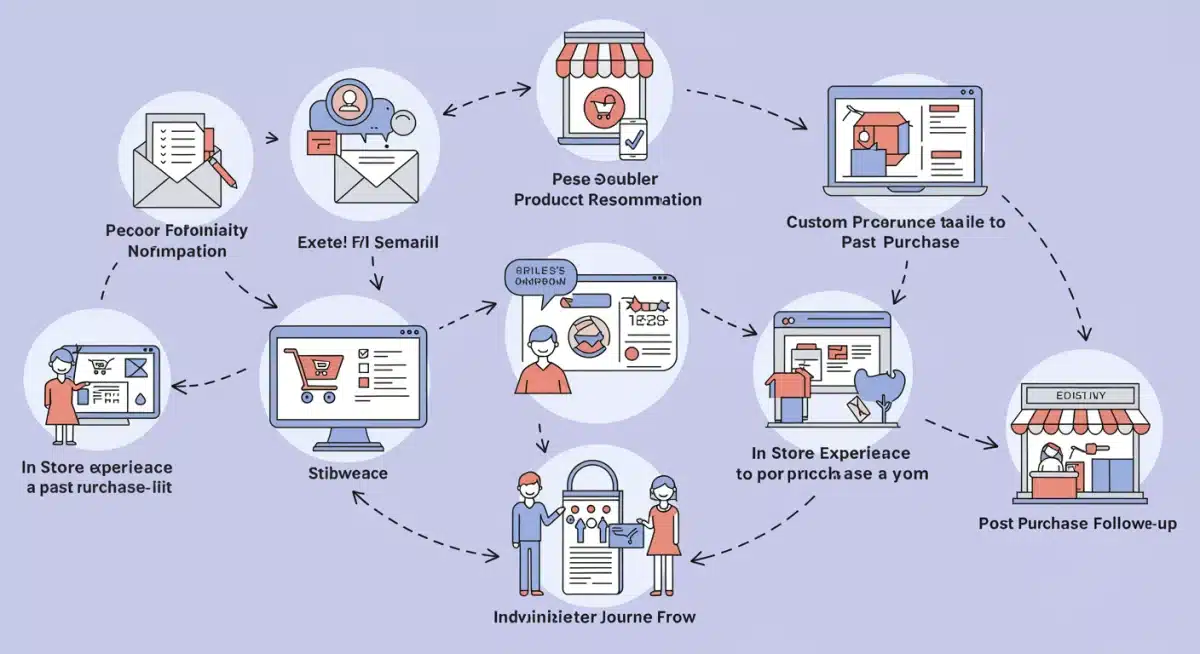
AI models can predict future purchasing behavior, identify customers at risk of churn, and recommend the most relevant products or content at the optimal time. For instance, a machine learning model might detect that a customer who frequently browses hiking gear in the fall is likely to purchase winter sports equipment in late autumn, prompting a timely, personalized offer.
Creating dynamic and adaptive customer journeys
Hyper-personalization extends beyond product recommendations to crafting entire customer journeys that adapt in real time. This means personalizing not just what a customer sees, but also how they interact with a brand across all channels.
- Personalized content: Dynamically adjust website content, email campaigns, and app notifications based on individual preferences.
- Tailored product discovery: Offer personalized search results, curated collections, and intelligent filtering options.
- Contextual offers: Deliver promotions and discounts that are relevant to the customer’s current situation, such as location or recent activity.
- Optimized channel engagement: Communicate with customers through their preferred channels at their preferred times.
The goal is to create a seamless, intuitive, and highly relevant experience that anticipates needs and exceeds expectations, making every interaction feel like a conversation rather than a broadcast.
By focusing on robust data infrastructure, intelligent AI, and dynamic customer journeys, businesses can effectively implement hyper-personalization strategies that not only meet the 20% retention goal but also build stronger, more profitable customer relationships.
Measuring the impact: metrics and KPIs
To truly understand the value of hyper-personalized commerce and ensure it contributes to the goal of 20% higher customer retention, businesses must establish clear metrics and key performance indicators (KPIs). Without proper measurement, it’s impossible to assess effectiveness, identify areas for improvement, and justify continued investment in personalization initiatives. The focus should be on metrics that directly reflect customer loyalty, engagement, and ultimately, profitability.
Tracking these metrics allows companies to iterate on their strategies, refining algorithms and content to maximize impact. It also provides tangible evidence of ROI, which is crucial for internal stakeholders. Measuring the impact isn’t just about proving success, it’s about continuously optimizing the personalization engine.
Key retention metrics to track
While the ultimate goal is increased retention, several specific metrics can help gauge progress and pinpoint the effectiveness of hyper-personalization efforts. These metrics provide a holistic view of customer behavior and loyalty.
- Customer churn rate: The percentage of customers who stop doing business with a company over a given period. A decrease indicates successful retention.
- Repeat purchase rate: The percentage of customers who make more than one purchase. Higher rates suggest increased loyalty.
- Customer lifetime value (CLTV): The total revenue a business can reasonably expect from a single customer account over their relationship. Hyper-personalization aims to increase this.
- Net promoter score (NPS): Measures customer loyalty by asking how likely customers are to recommend the company to others. Higher scores often correlate with better retention.
Monitoring these metrics before and after implementing hyper-personalization strategies provides clear evidence of its impact. Significant improvements in these areas directly contribute to the 20% retention target.
Engagement and conversion KPIs
Beyond direct retention metrics, examining engagement and conversion KPIs offers insights into how well personalized experiences are resonating with customers. These indicators show if the tailored content and offers are driving desired actions.
- Click-through rates (CTR) on personalized content: Higher CTRs on personalized emails, recommendations, or ads indicate relevance.
- Conversion rates: The percentage of personalized interactions that lead to a purchase or desired action.
- Time spent on site/app: Increased engagement time often signifies a more enjoyable and relevant experience.
- Average order value (AOV) for personalized offers: Analyzing if personalized promotions lead to larger purchases.
These metrics help optimize the personalization algorithms and content strategies, ensuring that the right message reaches the right customer at the right time, thereby maximizing engagement and conversion.
Attribution and ROI analysis
Attributing the uplift in retention and revenue specifically to hyper-personalization can be complex but is crucial for understanding ROI. Businesses need to implement robust attribution models that consider various touchpoints and the cumulative effect of personalized interactions.
Sophisticated analytics tools can help isolate the impact of personalized elements versus other marketing efforts. This allows for a clear calculation of the return on investment for hyper-personalization technologies and campaigns, demonstrating their value to the business and justifying further strategic allocation of resources.
By diligently tracking these diverse metrics and KPIs, businesses can not only confirm the effectiveness of their hyper-personalization strategies but also continuously refine them to achieve and surpass their retention goals.
Challenges and ethical considerations
While the promise of hyper-personalized commerce is immense, its implementation is not without significant challenges and ethical considerations. Navigating these complexities is crucial for building trust with customers and ensuring the long-term success of any personalization strategy. Businesses must balance the desire for deep customer understanding with respecting privacy and avoiding intrusive practices.
One primary challenge lies in the sheer volume and diversity of data required. Collecting, cleaning, and integrating data from disparate sources can be a monumental task, especially for larger organizations with legacy systems. Furthermore, the ethical implications of using personal data are becoming increasingly scrutinized by consumers and regulators alike.
Data privacy and security concerns
The extensive collection and analysis of personal data inherent in hyper-personalization raise significant privacy and security concerns. Customers are increasingly aware of their digital footprint and demand transparency and control over their information.
- Compliance with regulations: Adhering to strict data protection laws like GDPR and CCPA is non-negotiable. Non-compliance can result in hefty fines and reputational damage.
- Data breaches: The more data collected, the greater the risk of a breach. Robust security measures are essential to protect sensitive customer information.
- Transparency and consent: Clearly communicating how data is collected, used, and stored, and obtaining explicit consent from customers, builds trust.
- Anonymization and pseudonymization: Employing techniques to protect individual identities when data is used for analysis.
Failing to address these concerns can erode customer trust, leading to backlash and ultimately undermining the very goal of increased retention.
Avoiding the “creepy” factor
There’s a fine line between helpful personalization and intrusive surveillance. When personalization feels too accurate or predictive, it can cross into “creepy” territory, making customers uncomfortable and leading them to disengage. This “creepy” factor often arises when brands reveal an understanding of customers that feels unsolicited or goes beyond reasonable expectations.
For example, recommending a product a customer just discussed verbally near a smart device, or displaying ads for highly sensitive personal topics, can be deeply unsettling. Striking the right balance requires a deep understanding of customer psychology and a commitment to ethical data use. It means prioritizing relevance and value over mere data exploitation.
Algorithmic bias and fairness
AI and machine learning algorithms, while powerful, are only as unbiased as the data they are trained on. If historical data reflects existing societal biases, the algorithms can inadvertently perpetuate or even amplify these biases, leading to unfair or discriminatory personalized experiences.
- Data diversity: Ensuring training data is diverse and representative to minimize bias.
- Algorithmic auditing: Regularly reviewing algorithms for unintended biases and their impact on different customer segments.
- Fairness metrics: Developing and using metrics to assess the fairness of personalization outcomes across various demographic groups.
Addressing algorithmic bias is not only an ethical imperative but also a business necessity, as biased personalization can alienate significant portions of the customer base.
Successfully navigating these challenges requires a proactive approach to data governance, a strong ethical framework, and a continuous feedback loop with customers to ensure personalization remains helpful and respectful. Only then can businesses fully harness the power of hyper-personalization without compromising trust.
The future landscape of personalized retail
Looking ahead to 2025 and beyond, the future landscape of personalized retail promises to be even more immersive, intelligent, and integrated. Hyper-personalized commerce will continue to evolve, driven by advancements in AI, the Internet of Things (IoT), and extended reality (XR) technologies. This evolution will further blur the lines between online and offline shopping, creating truly omnichannel experiences that are seamlessly tailored to individual preferences at every turn.
The goal is to create a retail environment where every customer interaction feels intuitive and anticipatory, making shopping not just a transaction but a highly engaging and satisfying personal journey. Brands that embrace these future trends will be best positioned to capture and retain customer loyalty in an increasingly dynamic market.
Integration with virtual and augmented reality
Extended reality (XR), encompassing virtual reality (VR) and augmented reality (AR), is set to play a transformative role in personalized retail. These technologies offer new avenues for immersive product discovery and trial, all tailored to individual tastes.
- Virtual try-on: AR apps allowing customers to virtually try on clothes, makeup, or even furniture in their own homes, personalized to their body shape or living space.
- Personalized virtual showrooms: VR experiences where customers can explore curated product selections in a virtual store designed specifically for them.
- Interactive product customization: XR tools that enable customers to design and visualize custom products in real time, with personalized recommendations for features and styles.
These immersive experiences can significantly enhance engagement and confidence in purchasing, reducing returns and increasing satisfaction.
Proactive and predictive customer service
Hyper-personalization will extend deeply into customer service, transforming it from a reactive function into a proactive and predictive one. AI-powered systems will anticipate customer issues before they arise and offer personalized solutions.
Imagine a scenario where a smart home device detects a potential malfunction and automatically orders a replacement part, or a clothing brand proactively suggests a different size for an upcoming order based on a customer’s recent weight fluctuations (with consent, of course). This level of proactive service, driven by hyper-personalization, minimizes friction and significantly boosts customer satisfaction and loyalty.
Ethical AI and trust as competitive differentiators
As personalization becomes more sophisticated, so too will the consumer’s expectation for ethical data practices. Brands that prioritize ethical AI, transparent data usage, and robust privacy controls will distinguish themselves as trustworthy leaders.
Building and maintaining customer trust will become a primary competitive differentiator. Companies that can demonstrate a clear commitment to using data responsibly, offering customers control over their information, and ensuring algorithmic fairness will foster deeper loyalty and attract a more discerning customer base. The future of personalized retail isn’t just about technology; it’s about trust.
The future of personalized retail is bright and complex, demanding continuous innovation and a strong ethical compass. By embracing advanced technologies responsibly, businesses can create unparalleled customer experiences that secure loyalty and drive sustained growth for years to come.
Case studies and success stories
The theoretical benefits of hyper-personalized commerce are compelling, but real-world examples truly illustrate its transformative power. Numerous companies across various sectors have successfully implemented hyper-personalization strategies, achieving significant improvements in customer retention, engagement, and revenue. These success stories provide valuable insights into best practices and demonstrate the tangible outcomes of a customer-centric approach.
These case studies often highlight how a deep understanding of customer data, combined with innovative technological applications, can lead to remarkable results. They serve as inspiration and proof points for businesses considering or currently investing in hyper-personalization.
Netflix: mastering content recommendations
Netflix is perhaps the quintessential example of hyper-personalization in action. Its sophisticated recommendation engine, powered by advanced machine learning, analyzes viewing history, ratings, search queries, and even the time of day a user watches content to suggest highly relevant movies and TV shows. This personalization is so effective that it’s estimated to save the company over $1 billion per year by reducing churn.
- Individualized home screens: No two Netflix home screens are exactly alike, tailored to each user’s unique taste profile.
- Dynamic thumbnails: Even the artwork displayed for a title can be personalized to appeal to different users.
- Anticipatory suggestions: Recommending content a user is likely to enjoy, even before they know they want to watch it.
Netflix’s success underscores the power of hyper-personalization in content consumption, directly contributing to its high subscriber retention rates.
Starbucks: personalized mobile ordering and loyalty
Starbucks has effectively leveraged its mobile app and loyalty program to deliver hyper-personalized experiences. By combining purchase history, location data, and real-time preferences, Starbucks offers tailored promotions and recommendations.
The app remembers a customer’s favorite drinks and food, suggests new items based on past orders, and offers personalized rewards. This level of convenience and relevance encourages frequent visits and strengthens customer loyalty, making the Starbucks app a central part of many customers’ daily routines.
Amazon: the pioneer of product recommendations
Amazon set the gold standard for personalized product recommendations early on. Its “customers who bought this also bought” and “recommended for you” features are deeply integrated into the shopping experience. By analyzing vast amounts of purchase and browsing data, Amazon consistently presents relevant products, driving impulse buys and increasing average order value.
The continuous refinement of its recommendation engine, alongside personalized email marketing and dynamic website content, has been a key factor in Amazon’s unparalleled customer retention and market dominance. Their ability to anticipate needs and make shopping effortless is a direct result of their hyper-personalization efforts.
These case studies demonstrate that hyper-personalized commerce is not just a theoretical concept but a proven strategy for building stronger customer relationships and achieving significant business growth. By learning from these leaders, other businesses can chart their own path to increased retention and market success.
Preparing your business for the hyper-personalization era
As the retail landscape rapidly shifts towards hyper-personalized commerce, businesses that fail to adapt risk falling behind. Preparing for this new era requires more than just adopting new technologies; it demands a fundamental shift in mindset, prioritizing the customer experience above all else. It involves strategic planning, investment in the right tools, and a cultural transformation within the organization.
The journey to hyper-personalization is continuous, requiring ongoing optimization and a willingness to experiment. Businesses must foster a culture of data-driven decision-making and customer-centric innovation to thrive in this evolving environment.
Assessing current capabilities and identifying gaps
The first step in preparing for hyper-personalization is to conduct a thorough assessment of your current technological infrastructure, data management practices, and customer engagement strategies. This helps identify existing strengths and critical gaps that need to be addressed.
- Data audit: Evaluate the quality, completeness, and accessibility of your customer data across all channels.
- Technology stack review: Assess current CRM, e-commerce, marketing automation, and analytics platforms for their compatibility with hyper-personalization tools.
- Organizational readiness: Determine if your teams have the necessary skills and understanding of data science and AI.
Understanding where you stand is crucial for developing a realistic roadmap and prioritizing investments.
Investing in the right technology and talent
Successfully implementing hyper-personalization requires significant investment in both technology and human capital. This includes acquiring or upgrading platforms like CDPs, AI/ML tools, and real-time analytics solutions, as well as hiring or training talent with specialized skills.
Bringing in data scientists, machine learning engineers, and customer experience strategists is vital. These experts can design, implement, and manage the complex systems required for effective hyper-personalization. Furthermore, ongoing training for existing staff ensures that the entire organization understands and supports the personalization initiatives.
Fostering a customer-centric culture
Technology alone cannot deliver hyper-personalization; it must be supported by a deeply customer-centric culture. Every department, from marketing and sales to product development and customer service, must be aligned around the goal of delivering exceptional, personalized experiences.
This involves breaking down internal silos, encouraging cross-functional collaboration, and empowering employees to make data-informed decisions that benefit the customer. A customer-centric culture ensures that personalization is integrated into every aspect of the business, making it an inherent part of the brand’s identity rather than just a marketing tactic.
By systematically assessing capabilities, making strategic investments, and cultivating a customer-centric culture, businesses can effectively prepare for and capitalize on the hyper-personalization era, securing a competitive advantage and driving significant customer retention gains by 2025.
| Key Aspect | Brief Description |
|---|---|
| Definition | Real-time, AI-driven tailored experiences for individual customers, anticipating needs. |
| Retention Goal | Aims for 20% higher customer retention by 2025 through deep engagement. |
| Key Technologies | AI, Machine Learning, Big Data Analytics, Customer Data Platforms (CDPs). |
| Challenges | Data privacy, avoiding “creepy” factor, algorithmic bias, and security. |
Frequently asked questions about hyper-personalized commerce
Personalization uses basic customer data to tailor experiences, like addressing a customer by name. Hyper-personalization goes much further, using AI and real-time data to create unique, predictive, and context-aware experiences for individual customers across all touchpoints, often anticipating their needs before they express them.
By delivering highly relevant content, product recommendations, and offers, hyper-personalization makes customers feel understood and valued. This enhances satisfaction, builds deeper loyalty, reduces friction in the shopping journey, and ultimately decreases churn, leading to higher retention rates and increased customer lifetime value.
Key technologies include Artificial Intelligence (AI) and Machine Learning (ML) for predictive analytics, Big Data analytics for processing vast datasets, and Customer Data Platforms (CDPs) to unify customer information. Real-time data processing capabilities are also crucial for delivering immediate, relevant experiences.
Ethical concerns primarily revolve around data privacy and security, ensuring compliance with regulations like GDPR and CCPA. Additionally, businesses must avoid the “creepy” factor by not being overly intrusive, and address potential algorithmic biases to ensure fair and equitable treatment for all customer segments.
Yes, while large enterprises have more resources, smaller businesses can start with targeted personalization efforts using readily available tools. Focusing on a few key customer segments, leveraging basic analytics from e-commerce platforms, and using personalized email marketing can be effective first steps towards a more hyper-personalized approach.
Conclusion
The trajectory of retail is undeniably heading towards a future defined by hyper-personalized commerce. The projection of a 20% higher customer retention by 2025 is not merely an optimistic forecast but a tangible outcome for businesses that strategically embrace this paradigm shift. By leveraging advanced AI, robust data infrastructure, and a deep commitment to understanding individual customer needs, companies can move beyond generic interactions to create truly bespoke experiences. While challenges related to data privacy and ethical implementation persist, the rewards of fostering unparalleled customer loyalty and driving sustainable growth are significant. As consumers continue to demand more relevant and intuitive interactions, hyper-personalization will remain at the core of successful retail strategies, transforming transactional relationships into enduring partnerships.