Attribution Modeling: Optimizing US Ad Spend by 25% in 2025

Attribution modeling in digital marketing is crucial for optimizing US ad spend by 25% through data-driven approaches in 2025, enabling businesses to precisely allocate resources and enhance marketing effectiveness.
In the dynamic landscape of modern commerce, understanding where your marketing dollars truly make an impact is paramount. This is especially true for businesses in the United States looking to gain a competitive edge. This article delves into how attribution modeling US digital marketing strategies can optimize ad spend by an impressive 25% by 2025, leveraging data-driven approaches.
The imperative of attribution modeling in today’s market
The digital marketing ecosystem is more complex than ever, with consumers interacting across numerous touchpoints before making a purchase. Without a clear understanding of which touchpoints contribute most effectively to conversions, businesses risk misallocating significant portions of their advertising budgets. Attribution modeling provides the framework to accurately measure the impact of each marketing channel.
For US businesses, where ad spend can run into billions annually, even a small percentage of optimization translates into substantial savings and increased ROI. The shift from traditional ‘last-click’ models to more sophisticated methodologies is not merely a trend but a strategic necessity for sustainable growth.
Beyond last-click: A holistic view
Many marketers still rely on simplified attribution models, primarily last-click, which credits the final interaction before conversion. While easy to implement, this approach often overlooks the crucial role played by earlier touchpoints in the customer journey.
- Inaccurate budget allocation: Over-investing in bottom-of-funnel channels and underfunding awareness-building efforts.
- Missed optimization opportunities: Failing to identify high-performing channels that initiate customer interest.
- Incomplete customer journey understanding: Lacking insight into the full path a customer takes to conversion.
Adopting a more holistic view through advanced attribution models allows marketers to see the bigger picture, ensuring every dollar spent contributes meaningfully to the overall marketing objective. This granular insight is the bedrock of achieving significant ad spend optimization.
The imperative to move beyond simplistic models is driven by the increasing sophistication of consumer behavior and the availability of advanced analytical tools. Businesses that embrace comprehensive attribution modeling are better positioned to understand their customers and, consequently, build more effective and efficient marketing campaigns.
Understanding different attribution models and their applications
Choosing the right attribution model is critical for accurately assessing marketing performance and optimizing ad spend. There isn’t a one-size-fits-all solution; the best model depends on a business’s specific goals, customer journey, and data availability.
Various models offer different perspectives on how credit is assigned to touchpoints along the customer journey. Each has its strengths and weaknesses, making a thoughtful selection process essential for maximizing insights.
Common attribution models explained
Let’s explore some of the most prevalent attribution models beyond last-click and first-click, which are often too simplistic for today’s complex journeys.
- Linear Attribution: This model distributes credit equally across all touchpoints in the customer journey. It provides a balanced view, acknowledging every interaction’s role, but might not reflect the true impact of each.
- Time Decay Attribution: Assigns more credit to touchpoints that occurred closer in time to the conversion. This model is useful when recent interactions are considered more influential, reflecting a diminishing impact over time.
- U-shaped Attribution: Gives 40% credit to the first interaction, 40% to the last interaction, and the remaining 20% is distributed evenly among the middle interactions. It emphasizes both discovery and conversion points.
- W-shaped Attribution: Similar to U-shaped, but also gives significant credit to the mid-point touchpoint (the lead creation touchpoint), distributing 30% to first, 30% to last, 30% to mid, and 10% to the remaining interactions. This is ideal for longer sales cycles.
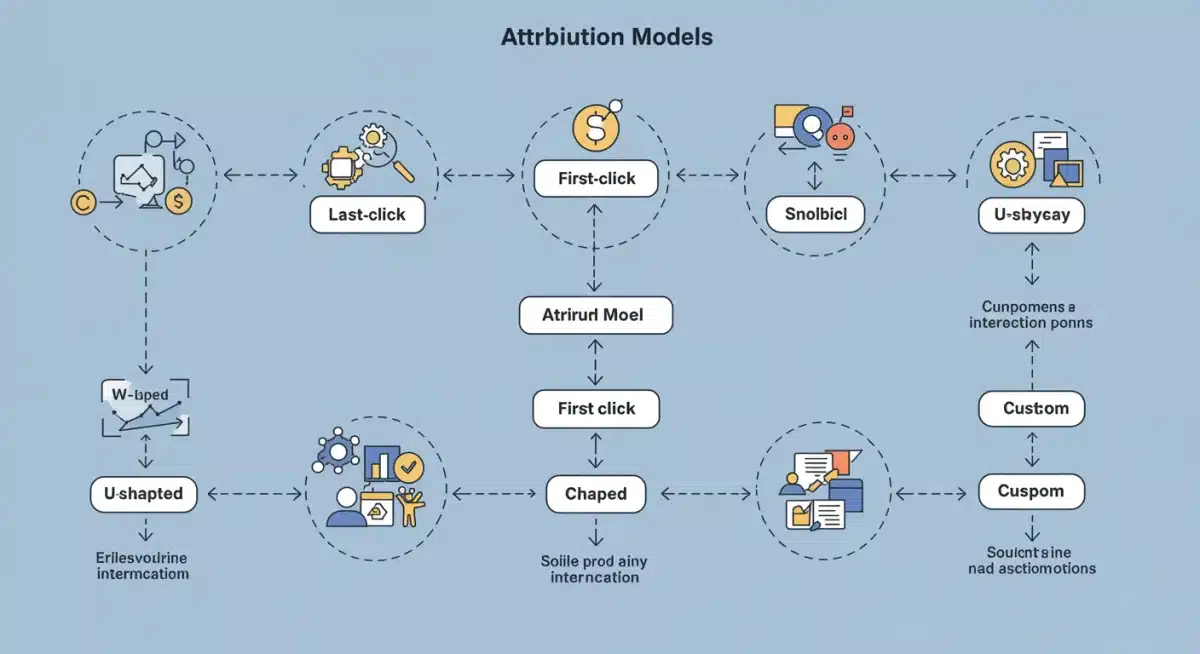
Each of these models offers a distinct lens through which to view marketing effectiveness. The key is to select a model, or even a combination of models, that aligns with the specific objectives of the marketing campaign and the nuances of the customer’s path to purchase.
Ultimately, the selection of an attribution model should be an iterative process, driven by experimentation and continuous analysis. By testing different models, businesses can gain deeper insights into their marketing performance and make more informed decisions about budget allocation.
Leveraging data-driven approaches for US ad spend optimization
Achieving a 25% optimization in US ad spend by 2025 isn’t just a lofty goal; it’s an attainable reality through rigorous data-driven strategies. This involves more than just selecting an attribution model; it’s about integrating data across platforms, employing advanced analytics, and fostering a culture of continuous testing and learning.
The sheer volume of data generated by digital marketing activities presents both a challenge and an immense opportunity. Businesses that can effectively collect, analyze, and act upon this data will be the ones to realize significant gains in efficiency and ROI.
Integrating data for a unified view
A fragmented view of customer interactions across disparate systems is a major impediment to effective attribution. True data-driven optimization requires integrating data from all marketing channels, CRM systems, website analytics, and offline touchpoints.
- Centralized data platforms: Utilizing Customer Data Platforms (CDPs) or robust data warehouses to consolidate all customer interaction data.
- API integrations: Connecting various marketing tools and platforms to ensure seamless data flow and real-time updates.
- Consistent data taxonomy: Establishing standardized naming conventions and tracking parameters across all campaigns for accurate comparison and analysis.
Once data is unified, marketers can build a comprehensive picture of the customer journey, identifying critical touchpoints and understanding their interdependencies. This integrated approach not only enhances attribution accuracy but also unlocks opportunities for personalized marketing and improved customer experiences.
The ability to connect the dots across every customer interaction, from initial exposure to final conversion, is what distinguishes leading marketers. This unified data perspective empowers them to make strategic decisions that directly impact the bottom line.
Implementing advanced attribution techniques for greater precision
While standard attribution models provide a good starting point, advanced techniques offer even greater precision, especially for complex customer journeys and diverse marketing portfolios. These techniques often involve more sophisticated statistical methods and machine learning algorithms.
Moving beyond rule-based models allows for a more nuanced understanding of marketing effectiveness, accounting for variables that simpler models might miss. This level of precision is key to unlocking significant optimization potential.
Algorithmic and custom attribution models
Algorithmic attribution models use machine learning to analyze all conversion paths and assign credit based on the statistical contribution of each touchpoint. These models can uncover non-obvious relationships and provide highly accurate insights.
- Shapley Value: A game theory concept adapted to attribution, it calculates the marginal contribution of each channel to a conversion, considering all possible orderings of touchpoints.
- Markov Chains: These models analyze the probability of a customer moving from one state (touchpoint) to another, allowing for the calculation of the removal effect of each channel.
- Custom Models: Businesses can develop bespoke attribution models tailored to their unique customer journey, industry specifics, and business objectives, often combining elements of various models.
The development and implementation of advanced models typically require specialized data science expertise or the use of sophisticated marketing analytics platforms. However, the investment often pays off significantly through superior budget allocation and improved campaign performance.
These advanced techniques provide a competitive edge by enabling marketers to move beyond assumptions and base their decisions on empirical evidence. The result is a more efficient marketing spend and a clearer path to achieving business goals.
Measuring impact and continuously optimizing ad spend
The journey of attribution modeling doesn’t end with implementation; it’s a continuous cycle of measurement, analysis, and optimization. To truly achieve and sustain a 25% optimization in US ad spend, businesses must establish robust measurement frameworks and adapt their strategies based on ongoing insights.
Effective measurement goes beyond simply tracking conversions; it involves understanding the incremental value of each marketing activity and continuously refining strategies to maximize that value.
Key performance indicators and iterative adjustments
To measure the impact of attribution modeling, marketers should focus on a range of KPIs that reflect both efficiency and effectiveness. These include Return on Ad Spend (ROAS), Customer Acquisition Cost (CAC), Lifetime Value (LTV), and conversion rates per channel.
- A/B testing of budget allocations: Experimenting with different budget distributions across channels based on attribution insights to identify optimal mixes.
- Regular performance reviews: Conducting weekly or monthly reviews of attribution data to identify trends, opportunities, and areas for improvement.
- Feedback loops with creative and content teams: Sharing attribution insights to inform creative development and content strategy, ensuring alignment with high-performing touchpoints.
The iterative nature of optimization means that initial attribution insights serve as a starting point, not a definitive answer. Marketing strategies should be agile, constantly adapting to new data, market shifts, and evolving customer behaviors.
By establishing a culture of continuous learning and optimization, businesses can ensure their ad spend remains highly efficient and effective, constantly driving towards better results and maintaining a competitive advantage in the US market.
The future of attribution modeling in the US market: 2025 and beyond
As we approach 2025, the landscape of digital marketing and attribution modeling in the US is set for further evolution. Emerging technologies and changing privacy regulations will undoubtedly shape how businesses approach understanding their marketing effectiveness. Anticipating these shifts is crucial for maintaining a competitive edge.
The drive for greater personalization, coupled with increasing consumer demand for data privacy, will necessitate even more sophisticated and ethical approaches to attribution. The future will belong to those who can balance these competing demands effectively.
Emerging trends and challenges
Several key trends are poised to impact attribution modeling significantly:
- Privacy-centric attribution: With stricter data privacy regulations (e.g., California Consumer Privacy Act – CCPA) and the deprecation of third-party cookies, privacy-preserving attribution methods, such as server-side tracking and first-party data strategies, will become paramount.
- AI and machine learning advancements: AI will play an even larger role in predictive analytics and automated optimization of ad spend, moving beyond current algorithmic models to more dynamic, real-time adjustments.
- Cross-device and offline integration: The ability to seamlessly connect customer journeys across multiple devices and integrate offline conversions (e.g., in-store purchases) will become more robust, offering a truly holistic view.
- Unified commerce analytics: A move towards integrating marketing attribution with broader business intelligence, linking ad spend directly to overall business performance and profitability across all sales channels.
These trends present both opportunities and challenges. Businesses that proactively adapt their attribution strategies to incorporate these advancements will be best positioned to optimize their US ad spend effectively in the coming years.
The future of attribution modeling is one of increasing complexity, but also of unparalleled insight. By embracing innovation and adapting to a rapidly changing environment, US businesses can not only meet but exceed their ad spend optimization goals.
| Key Point | Brief Description |
|---|---|
| Beyond Last-Click | Move from simplistic models to understand the full customer journey and optimize budget allocation. |
| Data Integration | Centralize data from all channels for a unified, comprehensive view of customer interactions. |
| Advanced Models | Implement algorithmic or custom attribution models for greater precision in assigning credit. |
| Continuous Optimization | Regularly measure KPIs and iterate strategies based on ongoing attribution insights. |
Frequently asked questions about attribution modeling
Attribution modeling is a framework that helps marketers understand which touchpoints in a customer’s journey contribute to a conversion. It assigns credit to various marketing channels, allowing businesses to evaluate their effectiveness and optimize their ad spend more efficiently.
Last-click attribution credits only the final interaction before a conversion, ignoring all preceding touchpoints. This can lead to misinformed budget allocation, as it fails to recognize the value of channels that initiate or nurture customer interest earlier in the journey.
Integrating data from all marketing channels, CRM, and analytics platforms provides a holistic view of the customer journey. This unified data allows for more accurate tracking and credit assignment, leading to better insights and more effective ad spend optimization.
Advanced models, like algorithmic or custom attribution, offer greater precision by analyzing complex relationships between touchpoints. They help uncover hidden insights, optimize budget allocation more effectively, and provide a deeper understanding of marketing ROI, leading to significant efficiencies.
AI and machine learning will enhance attribution modeling by enabling predictive analytics, automated optimization, and real-time adjustments to ad spend. This will allow for more dynamic and efficient resource allocation, adapting quickly to changing market conditions and consumer behaviors.
Conclusion
The pursuit of optimizing US ad spend by 25% through data-driven approaches in 2025 is not just an aspirational goal but a tangible objective for businesses committed to leveraging the full power of digital marketing. By moving beyond simplistic attribution models, integrating disparate data sources, embracing advanced analytical techniques, and committing to continuous optimization, marketers can unlock unprecedented efficiencies and drive superior marketing ROI. The future of digital marketing demands a precise, data-centric approach to attribution, ensuring every marketing dollar is invested wisely and effectively.