Voice Commerce Adoption: 2025 Forecast for US Online Purchases

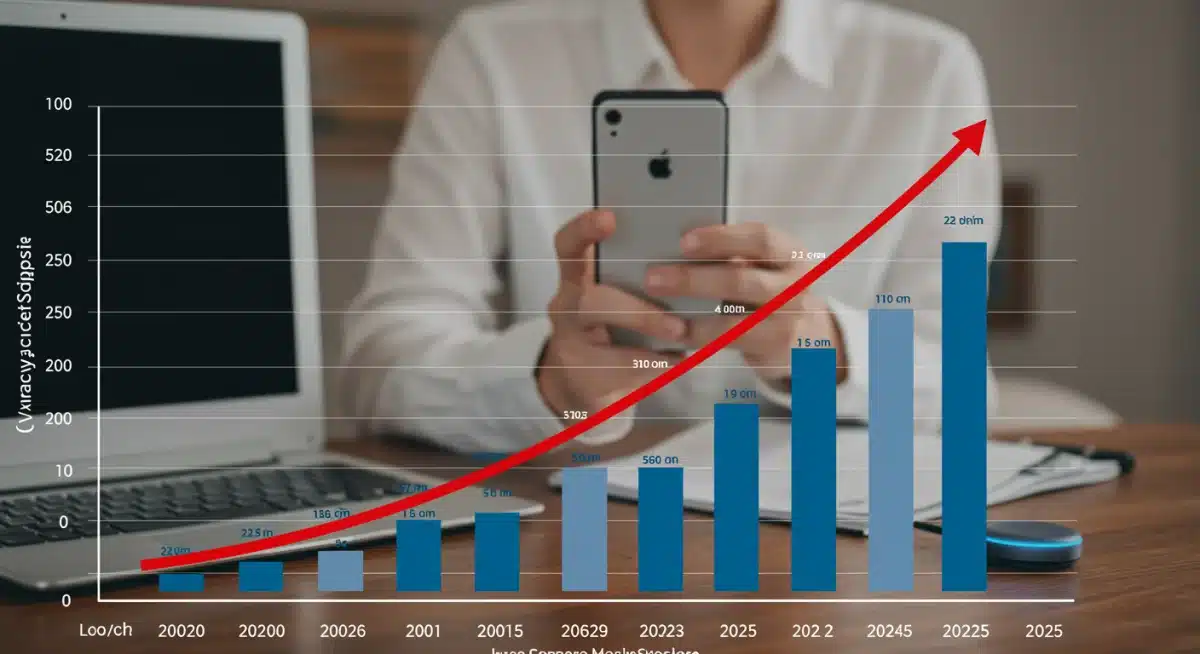
The 2025 forecast indicates that voice commerce adoption will account for 10% of US online purchases, primarily driven by the increasing integration and sophistication of smart devices in everyday consumer lives.
The digital retail landscape is undergoing a profound transformation, with emerging technologies continually redefining how consumers interact with brands and make purchases. One of the most compelling shifts on the horizon is the rapid acceleration of voice commerce adoption, poised to capture a significant share of the market.
The rise of voice commerce: a new era for online shopping
Voice commerce, the act of purchasing goods and services using voice commands through smart devices, is no longer a futuristic concept but a burgeoning reality. This section delves into the foundational elements driving its ascent and why it’s becoming an indispensable part of the e-commerce ecosystem.
The convenience offered by voice-activated assistants like Amazon Alexa, Google Assistant, and Apple’s Siri has profoundly impacted how consumers search for information, manage their schedules, and increasingly, shop. These intelligent platforms are seamlessly integrating into daily routines, making hands-free shopping an attractive alternative to traditional methods.
Smart devices as catalysts for adoption
The proliferation of smart speakers and smart displays in American households has been a primary driver behind the rapid growth of voice commerce. These devices serve as intuitive gateways, simplifying the purchasing process and making it accessible to a broader demographic.
- Ubiquitous presence: Smart speakers are now common fixtures in homes, cars, and even workplaces.
- Enhanced accessibility: Voice interfaces cater to users with limited mobility or those multitasking.
- Continuous innovation: Device manufacturers constantly improve voice recognition accuracy and natural language processing.
The evolution of artificial intelligence and machine learning algorithms further refines the user experience, allowing devices to understand complex commands and context with greater precision. This technological sophistication is critical for building consumer trust and encouraging repeated use for transactional purposes.
As smart devices become more sophisticated and integrated into our daily lives, the friction associated with online shopping diminishes. From reordering household staples to exploring new products, voice commands offer a frictionless path to purchase, a key factor in its projected market penetration.
Forecasting 10% of US online purchases by 2025
The prediction that 10% of all US online purchases will be driven by smart devices via voice commerce by 2025 represents a significant milestone. This forecast is not merely an optimistic projection but is grounded in current growth trajectories, technological advancements, and shifting consumer behavior patterns.
Several analytical reports and market studies corroborate this trend, highlighting the accelerating pace at which consumers are embracing voice-activated shopping. This shift is particularly evident in categories like groceries, household essentials, and digital content, where repetitive purchases and convenience are paramount.
Key factors influencing market penetration
Understanding the underlying factors contributing to this substantial market penetration is crucial for businesses aiming to capitalize on the voice commerce wave. It’s a confluence of technological readiness, consumer comfort, and strategic business investments.
- Improved accuracy: Voice recognition systems are now highly accurate, minimizing errors and frustration.
- Personalization: AI-driven recommendations tailored to individual preferences enhance the shopping experience.
- Secure transactions: Advancements in biometric authentication and secure payment protocols build user confidence.
Moreover, the integration of voice commerce into existing retail ecosystems, both online and offline, is creating a seamless omnichannel experience. Consumers can start a shopping list with their voice assistant and complete the purchase on a mobile app or in-store, blurring the lines between different retail channels.
This projected growth underscores a fundamental change in how consumers expect to interact with brands. The demand for instant gratification and effortless transactions is propelling voice commerce into the mainstream, making it a critical component of any forward-thinking e-commerce strategy.
Consumer behavior and evolving expectations
The adoption of voice commerce is inextricably linked to evolving consumer behavior and their increasingly high expectations for convenience and efficiency. Modern consumers seek frictionless experiences that save time and effort, and voice-activated shopping perfectly aligns with these desires.
The shift towards hands-free interaction is particularly appealing in busy households or when multitasking. Imagine ordering groceries while cooking dinner or adding items to a shopping cart during a morning commute – these scenarios highlight the practical utility of voice commerce in everyday life.
The convenience imperative
Convenience has always been a powerful driver in retail, but voice commerce elevates it to a new level. The ability to make purchases without typing, clicking, or even looking at a screen significantly reduces the effort involved in online shopping.
- Time-saving: Quick reordering of frequently purchased items.
- Multitasking enablement: Shopping while performing other activities.
- Reduced cognitive load: Simple, natural language commands ease the purchasing process.
Furthermore, the personalized nature of voice assistants, which learn user preferences and purchasing habits over time, streamlines the decision-making process. This predictive capability allows for highly relevant product suggestions, making shopping more intuitive and enjoyable.
As consumers become more accustomed to interacting with AI for various tasks, their comfort level with voice-based transactions grows. This familiarity fosters trust and encourages greater reliance on smart devices for an expanding range of retail activities, reinforcing the predicted growth trajectory.
Technological advancements fueling adoption
The rapid advancements in artificial intelligence (AI), natural language processing (NLP), and machine learning (ML) are the technological backbone supporting the surge in voice commerce adoption. These innovations are continuously refining the capabilities of smart devices, making them more intelligent and reliable.
Improved voice recognition accuracy is paramount. Early voice assistants often struggled with accents, background noise, or complex phrasing, leading to frustrating user experiences. Today, these systems are far more robust, capable of understanding a wide array of commands with remarkable precision.
AI and NLP breakthroughs
The sophistication of AI and NLP algorithms allows smart devices to not only understand what is being said but also to interpret the underlying intent. This contextual understanding is crucial for processing nuanced purchase requests and providing accurate product recommendations.
- Contextual understanding: AI can infer user needs based on previous interactions and current context.
- Enhanced dialogue management: More natural and flowing conversations with voice assistants.
- Multi-turn capabilities: Devices can handle follow-up questions and complex purchasing scenarios.
Beyond understanding, advancements in speech synthesis are making voice assistant responses more natural and less robotic, further enhancing the user experience. A more human-like interaction fosters greater comfort and encourages users to engage more frequently and confidently with their devices for commerce.
Moreover, the integration of these technologies with backend e-commerce platforms is becoming more seamless. This allows for real-time inventory checks, personalized pricing, and efficient order fulfillment, all crucial components for a successful voice commerce ecosystem.
Challenges and opportunities for businesses
While the prospects for voice commerce are bright, businesses face both significant challenges and substantial opportunities in adapting to this evolving retail channel. Navigating this new landscape requires strategic planning, technological investment, and a deep understanding of consumer expectations.
One primary challenge is ensuring product discoverability. Unlike visual search on a website, voice search relies heavily on clear, concise product descriptions and effective SEO strategies tailored for spoken queries. Businesses need to optimize their product listings for voice search algorithms.
Optimizing for voice search and user experience
To succeed in the voice commerce arena, businesses must rethink their digital strategies, focusing on how products are found and purchased through auditory interfaces. This goes beyond traditional SEO and delves into conversational design.
- Voice SEO: Optimizing content for natural language queries and long-tail keywords.
- Streamlined checkout: Developing secure and frictionless voice-activated payment processes.
- Personalized recommendations: Leveraging AI to offer relevant products based on voice history.
Another opportunity lies in building brand loyalty through superior voice experiences. Brands that offer intuitive, helpful, and personalized voice interactions are more likely to retain customers. This includes providing excellent customer service through voice and making post-purchase support easily accessible.
Furthermore, businesses can leverage voice commerce to gather valuable insights into consumer preferences and behaviors. The data collected from voice interactions can inform product development, marketing campaigns, and overall business strategy, creating a competitive advantage.
The future landscape: beyond 2025
Looking beyond the 2025 forecast, the trajectory of voice commerce suggests an even more integrated and sophisticated role in the future of retail. The initial 10% market share is likely just the beginning, paving the way for further expansion and innovation in how we shop.
We can anticipate a future where voice assistants are not just transaction facilitators but intelligent shopping companions, capable of proactive recommendations, complex comparative shopping, and even predicting needs before they arise. This level of predictive intelligence will revolutionize consumer engagement.
Integration with augmented and virtual reality
The convergence of voice commerce with other immersive technologies like augmented reality (AR) and virtual reality (VR) holds immense potential. Imagine using voice commands to explore virtual showrooms or try on clothing in AR, enhancing the sensory experience of online shopping.
- Seamless omnichannel: Voice commands bridging physical and digital shopping experiences.
- Predictive purchasing: AI anticipating needs and suggesting purchases proactively.
- Immersive shopping: Voice-controlled AR/VR shopping environments.
Moreover, the development of more sophisticated biometric authentication methods will further enhance the security and ease of voice transactions. This will instill greater confidence in consumers, encouraging them to use voice for higher-value purchases and sensitive transactions.
The ethical considerations surrounding data privacy and responsible AI development will also play a crucial role in shaping the future of voice commerce. As the technology becomes more pervasive, ensuring transparency and user control over personal data will be paramount for sustained growth and adoption.
| Key Aspect | Brief Description |
|---|---|
| 2025 Forecast | 10% of US online purchases via voice commerce. |
| Key Drivers | Smart device proliferation, AI advancements, consumer convenience. |
| Business Challenges | Voice SEO, product discoverability, secure transactions. |
| Future Trends | Proactive AI, AR/VR integration, enhanced personalization. |
Frequently asked questions about voice commerce
Voice commerce refers to the act of making purchases using spoken commands through voice assistants on smart devices like smart speakers, smartphones, or smart displays. It allows for hands-free shopping, streamlining the process of ordering goods and services.
Its rapid growth is driven by the widespread adoption of smart devices, significant advancements in AI and natural language processing, and increasing consumer demand for convenience and frictionless shopping experiences. Personalization also plays a key role.
Currently, frequently purchased items like groceries, household essentials, and digital content are popular voice commerce categories. As trust and technology evolve, it is expected to expand to higher-value goods and more complex services.
Businesses face challenges such as optimizing for voice search (Voice SEO), ensuring product discoverability without visual cues, developing secure voice-activated payment systems, and creating seamless, intuitive conversational user experiences.
Preparation involves investing in voice search optimization for product listings, developing secure and user-friendly voice payment options, integrating voice assistants into their omnichannel strategy, and focusing on personalized customer experiences through AI.
Conclusion
The forecast for voice commerce adoption reaching 10% of US online purchases by 2025 signals a transformative period for digital retail. This significant shift is propelled by the pervasive presence of smart devices, continuous advancements in AI and NLP, and an overarching consumer demand for ultimate convenience. Businesses that proactively embrace this technology, optimizing for voice search, enhancing user experience, and ensuring secure transactions, will be best positioned to thrive in this evolving landscape. As voice commerce continues to mature, it promises not just a new way to shop, but a fundamentally integrated and intelligent retail experience that redefines consumer interaction with brands.