BI Dashboards: Driving 20% More Informed Decisions in US Commerce

Business Intelligence dashboards are transforming decision-making across US commerce, poised to drive a 20% increase in informed strategic choices by mid-2025, by providing real-time data insights and actionable metrics for businesses.
The landscape of US commerce is evolving at an unprecedented pace, demanding ever-smarter, data-driven decisions. In this dynamic environment, The Role of Business Intelligence Dashboards: Driving 20% More Informed Decisions in US Commerce by Mid-2025 stands out as a critical factor for success. These powerful tools are not just displaying data; they are actively shaping the future of how businesses operate and compete.
Understanding Business Intelligence Dashboards
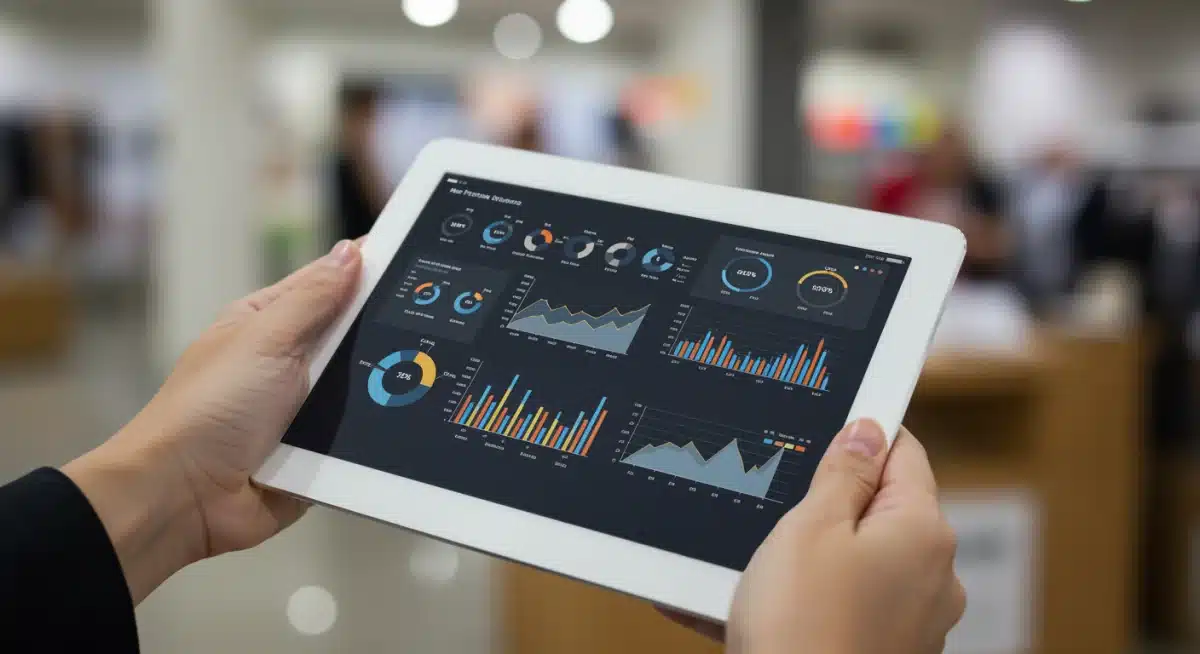
Business Intelligence (BI) dashboards are visual representations of key performance indicators (KPIs) and metrics, designed to provide at-a-glance insights into the health and performance of a business. They consolidate data from various sources into a single, intuitive interface, enabling users to monitor, analyze, and understand complex information quickly. In the context of US commerce, these dashboards are becoming indispensable tools for navigating market fluctuations and consumer behavior shifts.
The true power of a BI dashboard lies in its ability to transform raw data into actionable intelligence. Instead of sifting through spreadsheets and disparate reports, decision-makers can access real-time information presented in an easily digestible format. This immediate access to insights significantly reduces the time lag between data collection and strategic action, a crucial advantage in fast-paced commercial environments.
Key Components of an Effective BI Dashboard
An effective BI dashboard is more than just a collection of charts. It is a carefully curated display that focuses on the most critical metrics relevant to specific business objectives. These components work together to provide a comprehensive view of performance.
- Data Visualization: Utilizes charts, graphs, and other visual elements to make complex data understandable.
- Key Performance Indicators (KPIs): Focuses on specific metrics that directly measure progress towards business goals.
- Real-time Data: Provides up-to-the-minute information, reflecting current operational status and market conditions.
- Interactivity: Allows users to drill down into data, filter information, and customize views for deeper analysis.
These elements combine to create a powerful analytical tool that supports both strategic planning and day-to-day operational decisions. The ability to interact with data means that users can explore hypotheses and uncover hidden patterns, leading to more nuanced and informed choices.
In conclusion, BI dashboards serve as central command centers for data-driven commerce. By offering a consolidated, visual, and interactive view of critical business metrics, they empower organizations to move beyond guesswork and base their strategies on concrete evidence. This foundational understanding is crucial for appreciating their impact on decision-making.
The Impact on Decision-Making in US Commerce
The direct impact of BI dashboards on decision-making in US commerce is profound and multifaceted. They are not merely reporting tools; they are catalysts for change, enabling businesses to react faster, plan more effectively, and understand their customers deeply. This shift towards data-driven decisions is fundamentally reshaping competitive landscapes.
One of the most significant contributions is the enhancement of speed and agility. In a market where consumer preferences can shift overnight and supply chains face constant disruptions, the ability to make rapid, informed decisions is paramount. BI dashboards provide this agility by presenting relevant data instantly, allowing leaders to identify trends, pinpoint issues, and seize opportunities before they dissipate.
From Reactive to Proactive Strategies
Historically, many commercial decisions were made reactively, based on past performance reports or anecdotal evidence. BI dashboards flip this paradigm, fostering a proactive approach. By continuously monitoring real-time data, businesses can anticipate future challenges and opportunities.
- Early Trend Identification: Spotting emerging market trends or shifts in consumer behavior before they become widespread.
- Risk Mitigation: Identifying potential operational bottlenecks or financial risks in advance, allowing for preventive measures.
- Opportunity Seizure: Recognizing new market segments or product demands that can be capitalized upon quickly.
This proactive stance translates into a competitive edge, allowing businesses to stay ahead of the curve rather than constantly playing catch-up.
Moreover, BI dashboards democratize data access within an organization. No longer is critical information confined to the analytics department. Sales teams can monitor performance against targets, marketing teams can track campaign effectiveness, and operations can optimize logistics – all through tailored dashboards. This widespread access fosters a culture of data literacy and empowers employees at all levels to make better decisions within their purview.
Ultimately, the influence of BI dashboards extends beyond mere operational efficiency. They are instrumental in fostering a strategic mindset, enabling US commerce businesses to transform from data collectors into insightful decision-makers, thereby driving sustained growth and innovation.
Key Benefits for US Businesses by Mid-2025
As we approach mid-2025, the benefits of integrating BI dashboards into US commercial operations are becoming increasingly evident and quantifiable. These advantages extend across various aspects of a business, from operational efficiency to strategic market positioning, directly contributing to the projected 20% increase in informed decisions.
The primary benefit is undoubtedly enhanced operational efficiency. By providing clear visibility into processes, from inventory management to supply chain logistics, dashboards allow businesses to identify inefficiencies and bottlenecks. This leads to streamlined operations, reduced waste, and optimized resource allocation, directly impacting the bottom line.
Improved Customer Understanding and Personalization
In today’s competitive market, understanding the customer is paramount. BI dashboards offer a granular view of customer data, enabling businesses to segment audiences, analyze purchasing patterns, and predict future behavior. This leads to highly targeted marketing campaigns and personalized customer experiences.
- Customer Segmentation: Identifying distinct customer groups based on demographics, behavior, and preferences.
- Personalized Marketing: Delivering tailored messages and offers that resonate with individual customer segments.
- Enhanced Customer Service: Providing service agents with immediate access to customer history and preferences, improving resolution times and satisfaction.
This deep customer insight fosters stronger relationships and increases customer loyalty, a crucial factor for long-term success.
Furthermore, BI dashboards play a vital role in financial performance optimization. By tracking revenue streams, profit margins, and cost structures in real-time, businesses can make timely adjustments to pricing strategies, budgeting, and investment decisions. This financial transparency ensures that resources are allocated optimally and that financial goals are met.
In essence, by mid-2025, US businesses leveraging BI dashboards will experience a measurable uplift in their ability to make informed decisions across all departments. This will manifest as improved efficiency, deeper customer engagement, and stronger financial outcomes, cementing their position in a competitive market.
Challenges and Considerations for Implementation
While the benefits of BI dashboards are clear, their successful implementation in US commerce is not without challenges. Businesses must navigate several considerations to ensure that these powerful tools truly deliver on their promise of driving informed decisions. Addressing these challenges proactively is key to maximizing ROI and achieving the desired impact.
One of the primary hurdles is data integration. Commercial enterprises often operate with disparate data sources, ranging from CRM systems and ERP platforms to social media analytics and external market data. Consolidating and cleaning this data into a cohesive, usable format for a dashboard requires significant effort and robust data governance strategies.
Ensuring Data Accuracy and Security
The adage “garbage in, garbage out” holds true for BI dashboards. The insights generated are only as reliable as the data they are fed. Therefore, ensuring data accuracy and maintaining data quality are ongoing critical tasks. Additionally, with sensitive customer and financial information involved, data security is paramount.
- Data Validation Processes: Implementing rigorous checks to ensure the integrity and consistency of data inputs.
- Regular Data Audits: Periodically reviewing data sources and dashboard outputs for discrepancies.
- Robust Security Protocols: Protecting sensitive business and customer data from unauthorized access and breaches.
Without accurate and secure data, even the most sophisticated dashboard can lead to flawed decisions.
Another significant consideration is user adoption. Even the best BI dashboard will fail if employees are unwilling or unable to use it effectively. This requires not only intuitive design but also comprehensive training and ongoing support. Cultural resistance to new technologies or a lack of understanding of data’s value can hinder adoption rates.
In conclusion, successful BI dashboard implementation demands a holistic approach that goes beyond merely selecting software. It involves strategic planning, meticulous data management, robust security measures, and a strong focus on user training and change management to overcome potential obstacles and unlock the full potential of these transformative tools.
Strategies for Maximizing BI Dashboard Effectiveness
To truly drive a 20% increase in informed decisions by mid-2025, US commerce businesses must adopt strategic approaches to maximize the effectiveness of their BI dashboards. Simply having a dashboard is not enough; continuous refinement, user-centric design, and alignment with business objectives are crucial for unlocking their full potential.
A fundamental strategy involves defining clear, measurable objectives for each dashboard. Before building any dashboard, businesses should identify the specific questions they need to answer and the decisions they aim to influence. This ensures that the dashboard is focused, relevant, and provides actionable insights rather than just a deluge of data.
Fostering a Data-Driven Culture
The most effective BI dashboards are those embedded within a broader data-driven organizational culture. This means encouraging all employees, from executives to frontline staff, to embrace data as a fundamental part of their decision-making process. This culture shift requires leadership buy-in and consistent reinforcement.
- Leadership Advocacy: Executives actively using and promoting the use of dashboards in their daily work.
- Continuous Training: Providing ongoing education and resources to improve data literacy across the organization.
- Feedback Loops: Establishing mechanisms for users to provide feedback on dashboard utility and suggest improvements.
A strong data culture ensures that dashboards are not just tools, but integral components of day-to-day operations.
Furthermore, regular review and iteration are essential. Business environments are dynamic, and so too should be BI dashboards. Regularly assessing whether the dashboards are still meeting current business needs, updating KPIs, and incorporating new data sources ensures their continued relevance and effectiveness. This iterative process keeps dashboards aligned with evolving strategic priorities.
By implementing these strategies, US commerce businesses can move beyond basic data reporting to truly leverage BI dashboards as strategic assets. This proactive and adaptive approach will ensure that dashboards remain powerful drivers of informed decision-making, contributing significantly to business growth and competitiveness.
Future Trends and Evolution of BI Dashboards
The landscape of Business Intelligence is continuously evolving, and BI dashboards are at the forefront of this transformation. As we look towards mid-2025 and beyond, several key trends are poised to further enhance their capabilities and impact on US commerce, pushing the boundaries of what informed decision-making can achieve.
One prominent trend is the increasing integration of Artificial Intelligence (AI) and Machine Learning (ML) capabilities directly into dashboards. This integration will move dashboards beyond mere data visualization to predictive analytics and prescriptive insights. Imagine a dashboard not just showing current sales, but also predicting future sales with high accuracy and even suggesting optimal pricing strategies.
Augmented Analytics and Natural Language Processing
Augmented analytics, powered by AI, will simplify data exploration and insight generation. Users will be able to ask complex questions in natural language, and the dashboard will automatically generate relevant visualizations and explanations. This democratizes advanced analytics, making it accessible to a wider range of business users.
- Predictive Modeling: Dashboards will offer forecasts and risk assessments based on historical data and current trends.
- Prescriptive Recommendations: AI will provide actionable advice on what steps to take to achieve specific business outcomes.
- Natural Language Querying: Users can interact with dashboards using plain language, making data analysis more intuitive.
These advancements will significantly reduce the need for specialized data analysts for routine inquiries, empowering business users directly.
Another crucial trend is the shift towards more immersive and personalized dashboard experiences. This includes greater mobile accessibility, allowing decision-makers to access critical insights on the go, and highly customizable interfaces that cater to individual user roles and preferences. The goal is to make data insights seamlessly integrated into every aspect of a business professional’s workflow.
Ultimately, the future of BI dashboards in US commerce points towards more intelligent, intuitive, and integrated tools. These innovations will further solidify their role as indispensable assets, continually driving more informed, proactive, and strategic decisions, ensuring businesses remain agile and competitive in an ever-changing market.
| Key Aspect | Description |
|---|---|
| Real-time Insights | Dashboards provide immediate access to current data, enabling rapid response to market changes. |
| Proactive Decisions | Shift from reactive analysis to anticipating trends and mitigating risks effectively. |
| Customer Understanding | Deep dive into customer data for personalized marketing and improved service. |
| AI & ML Integration | Future dashboards will offer predictive analysis and prescriptive recommendations. |
Frequently Asked Questions About BI Dashboards
A BI dashboard is a visual interface displaying key business metrics from various sources in real-time. It’s crucial for US commerce as it transforms raw data into actionable insights, enabling faster, more informed decisions on market trends, customer behavior, and operational efficiency, significantly impacting competitiveness.
By providing immediate access to consolidated, easy-to-understand data, BI dashboards reduce decision-making time and improve accuracy. This enables businesses to identify opportunities, mitigate risks, and optimize strategies more effectively, leading to a measurable increase in the quality and speed of decisions across all departments.
Key challenges include integrating disparate data sources, ensuring data accuracy and security, and fostering user adoption. Overcoming these requires robust data governance, comprehensive training, and a strong organizational culture that values data-driven insights to maximize dashboard utility.
Absolutely. Effective BI dashboards are highly customizable, allowing each department (e.g., sales, marketing, operations, finance) to view specific KPIs and metrics relevant to their goals. This tailored approach ensures that the data presented is always pertinent and actionable for the respective teams.
AI and ML will transform dashboards from reporting tools into predictive and prescriptive engines. They will offer automated insights, trend forecasting, and even suggest optimal actions, making data analysis more intuitive and accessible, further enhancing the depth and speed of informed decision-making.
Conclusion
The journey towards driving a 20% more informed decision-making in US commerce by mid-2025 is clearly paved with the strategic implementation and evolution of Business Intelligence dashboards. These tools transcend simple data aggregation, becoming indispensable instruments for real-time insight, proactive strategy, and deep customer understanding. While challenges such as data integration and user adoption exist, a focused approach on clear objectives, data quality, and fostering a data-driven culture can unlock their full potential. As AI and Machine Learning continue to integrate, dashboards will become even more powerful, offering predictive and prescriptive capabilities that will redefine competitive advantage. For businesses in US commerce, embracing and optimizing BI dashboards is not merely an option, but a fundamental imperative for sustained growth and resilience in a rapidly changing market.