Predictive Analytics for US Retailers: Master Q3 2026 Sales Forecasting

In the fiercely competitive landscape of US retail, the ability to accurately predict future sales is not just an advantage; it’s a necessity. As we look towards Q3 2026, the stakes are higher than ever. Retailers are grappling with evolving consumer behaviors, supply chain complexities, and dynamic market conditions. The good news? Predictive analytics offers a powerful solution, enabling US retailers to forecast Q3 2026 sales with an unprecedented 90% accuracy. This isn’t merely about guessing; it’s about leveraging sophisticated data science to uncover actionable insights that drive strategic decision-making. By mastering retail sales forecasting, businesses can optimize inventory, refine marketing campaigns, enhance customer experiences, and ultimately, secure a stronger competitive position.
The journey to 90% accurate retail sales forecasting begins with a deep understanding of the underlying principles of predictive analytics. It involves collecting vast amounts of historical data, identifying patterns, and employing advanced algorithms to project future outcomes. For US retailers, this means moving beyond traditional methods that often rely on intuition or simple trend analysis. Instead, it calls for a data-driven approach that considers a multitude of variables, from macroeconomic indicators and competitor activities to localized events and individual customer preferences. The goal is to build robust models that can account for the inherent complexities and volatilities of the retail market, providing a clear, reliable roadmap for the future.
This comprehensive guide will delve into the critical components of successful predictive analytics for retail sales forecasting. We’ll explore the foundational elements, the cutting-edge technologies, and the strategic implementations necessary to achieve superior forecasting accuracy. Whether you’re a seasoned retail executive, a data scientist, or a business owner looking to gain a competitive edge, the insights provided here will equip you with the knowledge and tools to transform your forecasting capabilities and prepare your business for a prosperous Q3 2026 and beyond.
The Imperative of Accurate Retail Sales Forecasting
Why is achieving 90% accuracy in retail sales forecasting so critical for US retailers, especially for a specific period like Q3 2026? The answer lies in the cascading impact that accurate predictions have across the entire retail operation. Inaccurate forecasts can lead to a myriad of problems, including:
- Excess Inventory: Overstocking ties up capital, incurs storage costs, and increases the risk of markdowns and obsolescence. This directly impacts profitability.
- Stockouts: Understocking results in lost sales, frustrated customers, and damage to brand reputation. In today’s instant gratification economy, customers are quick to switch to competitors.
- Inefficient Staffing: Poor sales forecasts can lead to either overstaffing (unnecessary labor costs) or understaffing (poor customer service, missed sales opportunities).
- Suboptimal Marketing: Marketing efforts become less effective when not aligned with expected demand. Campaigns might target the wrong products or be launched at the wrong time.
- Supply Chain Disruptions: Retailers with inaccurate forecasts struggle to communicate effectively with suppliers, leading to delays, higher shipping costs, and strained relationships.
Conversely, highly accurate retail sales forecasting empowers retailers to:
- Optimize Inventory Levels: Maintain the right amount of stock, reducing carrying costs and minimizing stockouts, leading to improved cash flow and customer satisfaction.
- Enhance Customer Experience: Ensure product availability, offer personalized recommendations based on anticipated demand, and provide seamless service.
- Improve Financial Planning: Generate more reliable revenue projections, facilitate better budgeting, and support strategic investment decisions.
- Streamline Operations: Optimize staffing schedules, improve supply chain coordination, and enhance overall operational efficiency.
- Gain a Competitive Edge: React faster to market changes, identify emerging trends, and make proactive strategic moves that competitors might miss.
For Q3 2026 specifically, US retailers need to anticipate seasonal shifts, potential economic fluctuations, and evolving consumer spending habits. A 90% accuracy rate means a significantly reduced margin of error, translating into millions of dollars saved or gained, and a much stronger position in the market.
Foundational Elements of Predictive Analytics for Retail
Building a robust predictive analytics framework for retail sales forecasting requires several foundational elements. These are the building blocks upon which highly accurate models are constructed.
1. High-Quality Data Collection and Management
The adage ‘garbage in, garbage out’ holds particularly true for predictive analytics. The accuracy of your forecasts is directly proportional to the quality and breadth of your data. US retailers must prioritize collecting and managing a diverse set of data points, including:
- Historical Sales Data: Granular data on past transactions, including product IDs, quantities sold, prices, dates, times, and store locations. This is the bedrock of any sales forecast.
- Customer Data: Demographics, purchase history, browsing behavior, loyalty program data, and feedback. Understanding who your customers are and what they buy is crucial.
- Product Data: Attributes like category, brand, size, color, promotional history, and product lifecycle stages.
- Marketing and Promotional Data: Details of past campaigns, discounts, advertising spend, and their impact on sales.
- Supply Chain Data: Inventory levels, supplier lead times, shipping costs, and stock availability.
- External Data: Macroeconomic indicators (GDP, inflation, unemployment rates), local events (holidays, festivals, sporting events), weather patterns, competitor pricing, and social media trends.
Data must be clean, consistent, and integrated from various sources (POS systems, CRM, ERP, e-commerce platforms, third-party data providers). A robust data warehousing strategy and ETL (Extract, Transform, Load) processes are essential.
2. Advanced Statistical Modeling and Machine Learning
Once data is collected and prepared, the next step is to apply sophisticated analytical techniques. Traditional statistical methods like ARIMA (AutoRegressive Integrated Moving Average) and exponential smoothing have been staples in time-series forecasting. However, for 90% accuracy, especially in complex retail environments, machine learning (ML) models offer superior performance. These include:
- Regression Models: Linear Regression, Ridge, Lasso, and Elastic Net can model the relationship between sales and various influencing factors.
- Tree-Based Models: Decision Trees, Random Forests, Gradient Boosting Machines (GBM), and XGBoost are excellent at capturing non-linear relationships and interactions between variables.
- Neural Networks: Deep learning models, particularly Recurrent Neural Networks (RNNs) and Long Short-Term Memory (LSTM) networks, are highly effective for sequential data like time series, capturing complex temporal dependencies.
- Ensemble Methods: Combining multiple models (e.g., stacking, bagging, boosting) often yields more robust and accurate forecasts than any single model.
The choice of model depends on the data characteristics, the complexity of the problem, and the desired level of interpretability. Often, a combination of models, or a hybrid approach, proves most effective for retail sales forecasting.
3. Feature Engineering and Selection
Feature engineering is the process of creating new input variables (features) from existing data to improve the performance of machine learning models. For retail, this could involve creating features such as:
- Lagged Sales: Sales from previous days, weeks, or months.
- Rolling Averages: Average sales over a specific past period.
- Day of Week/Month/Year: Cyclical patterns.
- Holiday Indicators: Binary flags for holidays and surrounding periods.
- Promotional Impact: Duration and intensity of promotions.
- Weather Variables: Temperature, precipitation, specific weather events.
Feature selection, on the other hand, involves choosing the most relevant features to include in the model, reducing dimensionality, and preventing overfitting. This step is crucial for building efficient and accurate models for retail sales forecasting.
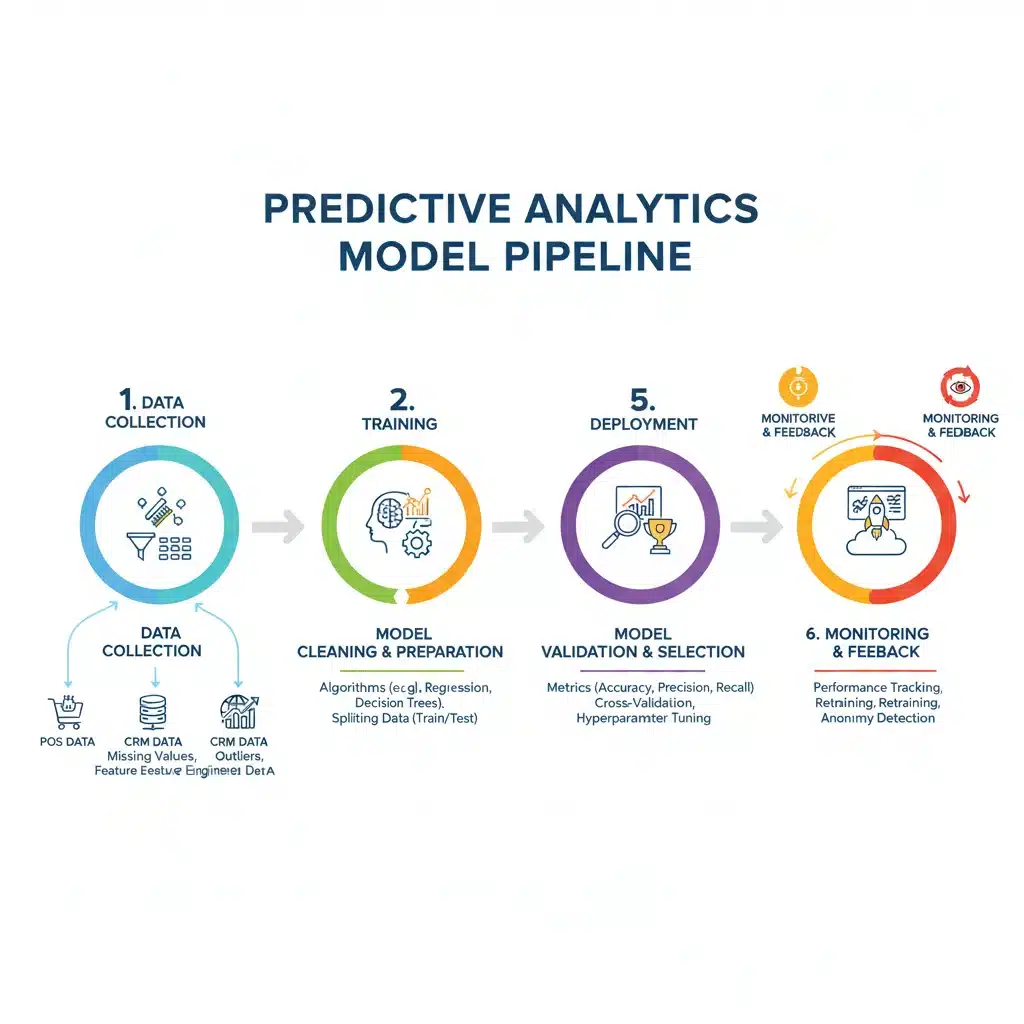
Implementing Predictive Analytics for Q3 2026 Sales Forecasting
The theoretical framework is only as good as its practical application. Here’s a step-by-step guide for US retailers to implement predictive analytics for Q3 2026 sales forecasting with 90% accuracy.
Step 1: Define Clear Objectives and Scope
Before diving into data, clearly define what you want to achieve. Are you forecasting at the SKU level, category level, store level, or regional level? What is the forecast horizon (e.g., weekly, monthly for Q3 2026)? What business decisions will be informed by these forecasts (e.g., inventory ordering, marketing budget allocation)? Clear objectives ensure that the project remains focused and delivers tangible value.
Step 2: Data Acquisition and Preprocessing
Gather all relevant internal and external data sources. This involves extracting data from various systems, cleaning it (handling missing values, outliers, inconsistencies), and transforming it into a format suitable for analysis. This step often consumes the most time in any predictive analytics project but is absolutely critical for achieving high accuracy in retail sales forecasting.
Step 3: Exploratory Data Analysis (EDA)
Conduct a thorough EDA to understand your data. Look for trends, seasonality, cyclical patterns, and anomalies. Visualize sales data over time, analyze correlations between sales and other variables (e.g., promotions, weather), and identify potential drivers of demand. EDA helps in formulating hypotheses and guides feature engineering.
Step 4: Model Development and Training
Select appropriate statistical and machine learning models based on your EDA and objectives. Split your data into training, validation, and test sets. Train your chosen models on the training data, then fine-tune their parameters using the validation set. Experiment with different algorithms and ensemble techniques to find the best performers. For retail sales forecasting, it’s often beneficial to develop multiple models (e.g., one for baseline, another for promotional impact, a third for macroeconomic factors) and combine their outputs.
Step 5: Model Evaluation and Refinement
Evaluate your models’ performance using relevant metrics on the test set. Common metrics for forecasting include Mean Absolute Error (MAE), Mean Squared Error (MSE), Root Mean Squared Error (RMSE), Mean Absolute Percentage Error (MAPE), and R-squared. For a target of 90% accuracy, MAPE is often a useful metric (meaning an average error of 10% or less). Analyze where the model performs well and where it struggles. Refine features, adjust model parameters, or even switch to different algorithms until the desired accuracy is achieved.
Step 6: Deployment and Monitoring
Once satisfied with the model’s performance, deploy it into a production environment. This often involves integrating the model with existing business intelligence tools, ERP systems, or custom applications. Crucially, models are not ‘set and forget.’ They need continuous monitoring to ensure their performance doesn’t degrade over time due to concept drift (changes in underlying data patterns). Regularly retrain models with new data to maintain their accuracy, especially for dynamic retail sales forecasting environments.
Step 7: Integration with Business Processes
The forecasts are only valuable if they are used. Integrate the predictive insights into your key business processes: inventory planning, merchandising, marketing, and supply chain management. Ensure that relevant stakeholders have access to the forecasts and understand how to interpret and act upon them. This step is vital for realizing the full benefits of accurate retail sales forecasting.
Key Technologies and Tools for US Retailers
To achieve 90% accuracy in retail sales forecasting, US retailers need to leverage a combination of robust technologies and tools. These can range from open-source libraries to sophisticated enterprise solutions.
Data Platforms
- Cloud Data Warehouses: Solutions like Snowflake, Amazon Redshift, Google BigQuery, and Azure Synapse Analytics provide scalable and cost-effective storage and processing for vast amounts of retail data.
- Data Lakes: For unstructured and semi-structured data, data lakes built on technologies like Hadoop or cloud object storage (Amazon S3, Azure Data Lake Storage) are essential.
Analytics and Machine Learning Platforms
- Cloud ML Platforms: AWS SageMaker, Google AI Platform, and Azure Machine Learning offer end-to-end solutions for building, training, and deploying ML models, simplifying the process for retail sales forecasting.
- Open-Source Libraries: Python libraries such as scikit-learn (for traditional ML), TensorFlow/Keras, and PyTorch (for deep learning), and Prophet (for time series forecasting) are powerful tools for data scientists. R also offers a rich ecosystem for statistical modeling.
- Business Intelligence (BI) Tools: Tableau, Power BI, and Looker are crucial for visualizing forecasts, tracking actuals against predictions, and presenting insights to business users.
Integration and Automation Tools
- ETL Tools: Talend, Fivetran, Stitch, or custom Python scripts are used to extract, transform, and load data from various sources into your data platform.
- Orchestration Tools: Apache Airflow or cloud-native schedulers (AWS Step Functions, Azure Data Factory) automate the data pipelines and model retraining processes, ensuring forecasts are always up-to-date.
Specialized Retail Solutions
Many vendors offer specialized retail forecasting software that integrates predictive analytics capabilities. While these can be powerful, it’s important to ensure they offer the flexibility and customization needed to achieve 90% accuracy, rather than being black-box solutions. Often, a hybrid approach combining off-the-shelf tools with custom-built models provides the best balance.

Challenges and Best Practices for US Retailers
While the promise of 90% accuracy in retail sales forecasting is compelling, there are challenges to navigate. Adopting best practices can help overcome these hurdles.
Common Challenges:
- Data Silos: Data residing in disparate systems without proper integration.
- Data Quality Issues: Incomplete, inconsistent, or inaccurate data.
- Lack of Data Science Expertise: Insufficient in-house skills to build and manage complex predictive models.
- Model Complexity vs. Interpretability: Highly accurate models can sometimes be difficult to understand, making it hard for business users to trust and act on their predictions.
- Dynamic Market Conditions: Unforeseen events (e.g., economic downturns, global pandemics, new competitors) can quickly render models obsolete.
- Resistance to Change: Employees accustomed to traditional forecasting methods may be hesitant to adopt new, data-driven approaches.
Best Practices for Success:
- Start Small, Scale Up: Begin with a pilot project on a specific product category or store to demonstrate value before rolling out across the entire organization.
- Foster Cross-Functional Collaboration: Bring together data scientists, business analysts, merchandising teams, marketing, and supply chain managers. Their combined expertise is invaluable for building relevant models and ensuring adoption.
- Invest in Data Governance: Establish clear policies and procedures for data collection, storage, quality, and access. This is fundamental for reliable retail sales forecasting.
- Continuous Learning and Iteration: Predictive models are not static. Regularly review and update them. Experiment with new features, algorithms, and data sources.
- Focus on Actionable Insights: Ensure forecasts are presented in a way that business users can easily understand and act upon. Provide clear recommendations based on the predictions.
- Develop a Hybrid Approach: Combine machine learning forecasts with expert judgment. Human intuition can sometimes catch nuances that models miss, especially during periods of high uncertainty.
- Scenario Planning: Beyond a single forecast, develop scenarios (best case, worst case, most likely) to prepare for various eventualities.
- Vendor Selection: If opting for external solutions, choose vendors with proven retail expertise, flexible platforms, and strong support for model customization and integration.
- Ethical AI Considerations: Ensure fairness and transparency in data usage and model development, avoiding biases that could lead to discriminatory outcomes.
The Future of Retail Sales Forecasting: Beyond Q3 2026
Achieving 90% accuracy in retail sales forecasting for Q3 2026 is a significant milestone, but the evolution of predictive analytics doesn’t stop there. The future promises even more sophisticated approaches:
- Prescriptive Analytics: Moving beyond ‘what will happen’ to ‘what should we do.’ Prescriptive models will not only forecast sales but also recommend optimal actions, such as dynamic pricing strategies, personalized promotions, or automated inventory reordering.
- Real-time Forecasting: Leveraging IoT devices, real-time sensor data, and immediate social media sentiment analysis to provide constantly updating forecasts, allowing for even more agile responses to market changes.
- Hyper-Personalization: Forecasting demand at an individual customer level, enabling truly one-to-one marketing and product recommendations.
- Explainable AI (XAI): As models become more complex, XAI will be crucial for understanding why a particular forecast was made, increasing trust and facilitating better decision-making.
- Integration with Generative AI: Generative AI could assist in creating synthetic data for model training, simulating market conditions, or even generating marketing copy optimized for forecasted demand.
US retailers who embrace these advancements will not only maintain their competitive edge but will redefine the very nature of retail operations. The ability to anticipate and adapt with speed and precision will be the hallmark of successful businesses in the years to come.
Conclusion
The quest for 90% accuracy in retail sales forecasting for Q3 2026 is an ambitious yet entirely achievable goal for US retailers willing to invest in predictive analytics. By focusing on high-quality data, leveraging advanced statistical and machine learning models, and adopting best practices in implementation and continuous refinement, businesses can transform their forecasting capabilities.
The benefits extend far beyond just knowing what to expect; they encompass optimized inventory, enhanced customer experiences, improved financial health, and a resilient, agile operation. The journey requires a strategic commitment to data-driven decision-making, cross-functional collaboration, and a willingness to embrace new technologies. As the retail landscape continues to evolve at a rapid pace, those who master retail sales forecasting will not merely survive but thrive, setting new benchmarks for efficiency, profitability, and customer satisfaction. The time to act is now, to ensure your business is fully prepared to capitalize on the opportunities of Q3 2026 and beyond.